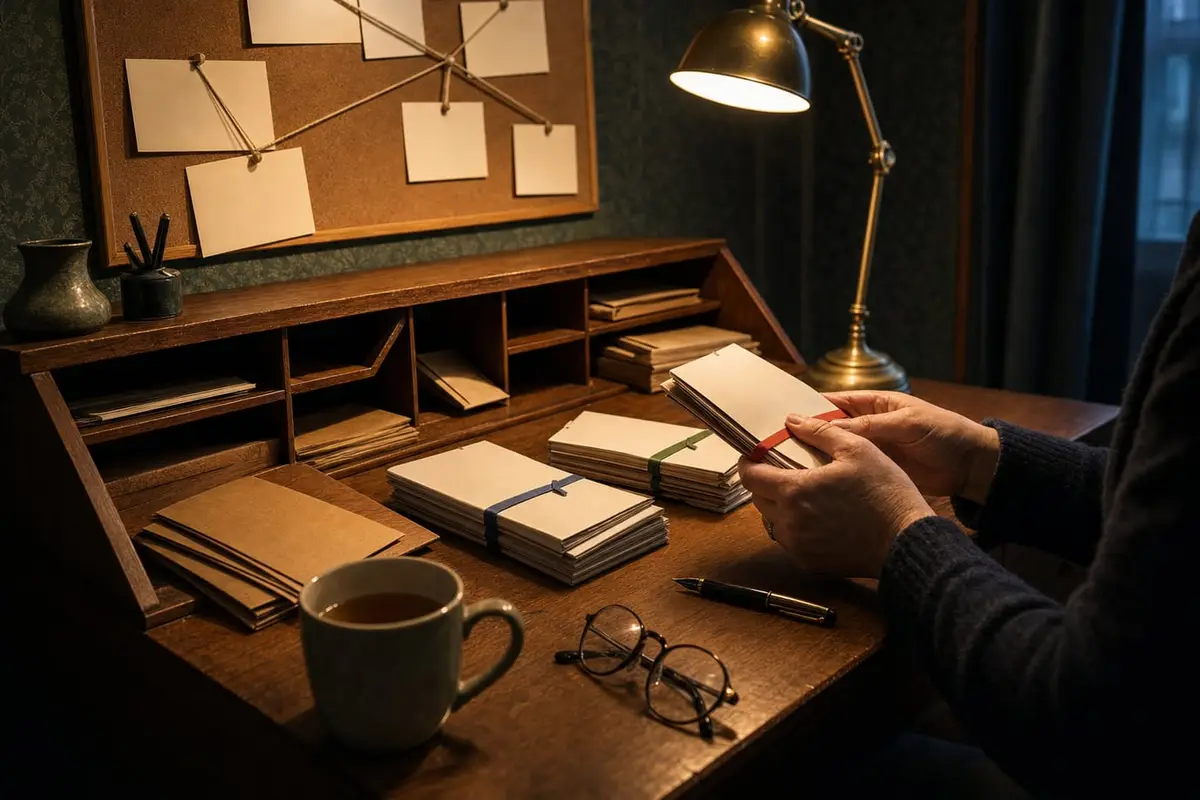
A murder mystery party script is the written material that runs the game: an introduction the host reads aloud, a booklet for each character, clues revealed round by round, and a solution read at the end. Boxed kits such as University Games' tell guests what to reveal each chapter; mingling kits like Night of Mystery give objectives instead of lines.
Murder mystery party script — The full set of written materials behind a murder mystery party: the host's introduction and run sheet, one character booklet per guest with public and secret information, clues released round by round, and the solution read aloud at the end.
We earn a commission when you buy through links on this page, at no extra cost to you. Commissions never decide which games we pick or their order. As an Amazon Associate I earn from qualifying purchases. Affiliate disclosure
What a murder mystery party script is
A murder mystery party script is everything written down that makes the game run without anyone improvising the plot: what the host reads, what each guest reads, what gets revealed when, and how the case ends. Without it you have a costume party; with it you have a solvable case.
The word covers two styles, and knowing which one you are buying saves an awkward evening.
- Fully scripted. Wikipedia’s entry on the genre says that in scripted murder mystery games participants are told exactly what to say and when, from booklets read around a table in rounds. Decipher’s How to Host a Murder series, first published in 1985 with The Watersdown Affair, popularized the format.
- Interactive (mix and mingle). Guests get a character background, confidential information and objectives, then improvise. Night of Mystery sells its games with the line “No scripts,” yet every kit still contains a host guide, character descriptions, round materials and a solution. That is a script too, just one that gives goals instead of lines.
If your guests are shy or new to the genre, a scripted kit gives them something to say. If they like to perform, an interactive one lets them run with it. Our comparison of a murder mystery game vs party helps if you are still deciding on the format itself.
The parts of a script
Whatever the publisher, the same pieces come back.
| Part | Who reads it | When | What it contains |
|---|---|---|---|
| Invitation and character intro | Each guest | Days before the party | Name, a few lines of personality, costume ideas |
| Host guide | The host | Before and during the party | Setup, casting notes, the order of rounds, what to say when |
| Opening | The host, aloud | Start of the party | The setting and the crime, or the events leading up to it |
| Character booklet | Each guest | Round by round | Public background, private secrets, what to reveal or find out in each round |
| Clues and evidence | Everyone | Released at set points | Documents, statements, a floor plan, a timeline |
| Accusation sheet | Each guest | Final round | Who did it, how and why |
| Solution | The host, aloud | At the end | The full explanation, often with awards afterward |
University Games’ Murder on Misty Island shows the scripted version step by step. The host reads a Police Report to everyone and leaves it in a central place. Guests open their booklets to the Background page only, the host reads the rules, and everyone introduces themselves. The party then moves through chapters: in each one, every guest reveals information about other guests from their booklet. Two evidence sheets appear in Chapter 3. After the final chapter, each guest accuses someone, giving who, why and how, and the authors’ solution is read aloud.
The rules are part of the script. In that kit, everyone must answer questions truthfully but need not volunteer more than asked, and only the murderer may lie. That single line is what makes the case solvable.
How the rounds work
A party script is paced in rounds so that information arrives in the right order. Night of Mystery’s mingling format runs like this: guests arrive already knowing their character, the host reads the introduction, first objectives go out, the murder happens mid-party, an Investigator (the host or a guest) reads how the game continues, new objectives and evidence follow, then accusations and the reveal. Its published sample timeline allows about 90 minutes for three rounds.
Who knows the culprit is the biggest design choice in a script:
- Nobody, at first. In Night of Mystery games, the victim and the killer do not know their fate until the game begins.
- Chosen on the night. Murderous Decisions picks the murderer during the party, which is why its games work with any combination of 6 to 14 guests. The publisher posts audio tracks for each act, with A and B versions for the branches.
- Known from the start, or only at the end. Wikipedia notes that in some versions the murderer is aware of the role from the outset, while in others it is revealed to everyone during the solution round.
Boxed, printable or homemade
| Boxed kit | Printable download | Write your own | |
|---|---|---|---|
| Examples | Murder Mystery Party: Pasta, Passion & Pistols (University Games, 8 players); Murder at the Pizzeria (Murderous Decisions, 6 to 14) | Night of Mystery games, sold in sizes up to 20+ guests | Your own story and cast |
| Guest count | Fixed or a set range | Buy the version that matches | Whatever you write |
| Preparation | Low: open, cast, send invitations | Printing, cutting, envelopes | Many evenings of writing |
| Can the host play? | Often | Yes, if the host skips the solution file | Not really: the author knows the answer |
| Replay | Some offer alternative endings | Rarely with the same guests | Never with the same guests |
Talking Tables’ Murder on the Train is one boxed kit that prints three alternative endings, so the same box can run again with a different culprit. To compare kits by cast size, difficulty and format, see how to choose a murder mystery party kit and our ranking of the best murder mystery party games.
How to write your own script: the main steps
Writing a script is closer to building a puzzle than writing a play. These are the stages, not a finished script.
- Start with the solution. Decide who did it, how, why and when, and write a minute-by-minute timeline of the evening of the crime. Everything else hangs on it.
- Play fair. Knox’s 1929 rules for detective stories still apply: the culprit must appear early, and every clue the solution relies on must reach the players. If guests can only guess, the reveal falls flat.
- Build the cast. One character per confirmed guest, each with a motive or a secret. University Games’ rules say all guests have motives and hidden pasts, which is what keeps the innocent ones interesting. Our guide to murder mystery party characters covers the classic archetypes and how many roles you need.
- Split the information. List every clue, then assign each one to a character and a round. Each round should move suspicion, and the culprit’s lie must be contradicted by something another guest holds.
- Write the booklets. A public background, private secrets, and a short section per round saying what to reveal and what to find out. Keep each round to a page.
- Write the host’s materials. An opening, a run sheet with times, the evidence to release, and a solution that explains who, how and why in that order.
- Walk the clue chain. Before the party, trace each clue from the booklet that holds it to the round in which it surfaces. A clue held by a guest who never has a reason to share it is a dead end.
What one round page looks like
A booklet page for a single round can be very short. An invented example for a suspect called the gardener:
- Reveal this round: you saw a light in the library at 9:40.
- Find out: who borrowed the greenhouse key yesterday.
- Hide unless asked directly: you argued with the host last week.
Three lines give a guest something to say, a reason to go and talk to someone, and a secret to protect. Multiply that by every guest and every round and the conversation runs itself.
Adapting a script to your guest list
Guest lists change, and a good script bends without breaking.
- Extra guests. University Games says guests who drop by without a role can still help solve the case by questioning the suspects. Murderous Decisions sells additional characters for larger groups or to change the gender mix.
- Fewer guests. Night of Mystery’s host files say which characters can be removed and which cannot. Never cut a role the solution depends on; read it yourself instead.
- Gender swaps. Most characters work with a new name and pronoun. Check the publisher’s gender breakdown before you buy.
- Younger players. Choose a kit written for teens or labeled clean rather than editing an adult script line by line.
Distributing the script and running the night
- Send backgrounds early, secrets late. University Games asks hosts to deliver invitations a few days ahead so guests can get into character; Night of Mystery sends the character description with the invitation. Keep round materials and the solution with you.
- Seal each round. Envelopes marked by round stop guests from reading ahead.
- Read the opening and the solution yourself, or play the publisher’s audio where it exists.
- Keep time. The host’s real job is pacing: announce each round and give a five-minute warning.
- Protect the ending. Night of Mystery asks guests not to post photos or mentions of the victim, the murderer or key clues.
The full evening plan, from invitations to an hour-by-hour timeline, is in our guide on how to host a murder mystery party.
Common mistakes
- Buying for the invite list. A script for eight does not stretch to eleven. Cast only confirmed guests.
- Putting a key clue on an unreliable guest. If the solution depends on someone who cancels, the case cannot be solved. Give essential roles to people who will show up.
- Too much reading. A booklet that takes ten minutes per round stalls the party.
- A culprit nobody can deduce. Check that the clues point to one person, not just away from the others.
- Spoiling it for yourself. If you want to play, read only the setup pages and leave the solution sealed.
- Graphic details. Keep the crime offstage and the evening on alibis and secrets; it reads as a party, not a horror night.
Where to go next
Once your script is chosen, the murder mystery party hub gathers the rest: casting, costumes, kits and the plan for the night.
Key facts
- In scripted murder mystery games, participants are told exactly what to say and when, often with introductory statements, questions to ask and answers to give, read from booklets in rounds; interactive games instead give character backgrounds and confidential information, add subplots and permit ad-libbing.Wikipedia, Murder mystery game, 2026
- University Games' Murder on Misty Island runs in this order: the host reads a Police Report, guests read only the Background page of their booklet, then a series of chapters in which each guest reveals information about others; two evidence sheets appear in Chapter 3, every guest accuses (who, why and how), and the authors' solution is read aloud.University Games, Murder on Misty Island party instructions, 2021
- The same rules require every player to answer questions truthfully without volunteering more than asked, and allow only the murderer to give untruthful answers.University Games, Murder on Misty Island party instructions, 2021
- Night of Mystery advertises its downloadable games with 'No scripts': guests receive character profiles with secrets and objectives, the victim and the killer do not know their fate until the game begins, and after the murder an Investigator, played by the host or a guest, reads how the game continues.Night of Mystery, A Knight of Murder introduction file, 2025
- Murderous Decisions games play with any combination of 6 to 14 guests and choose the murderer on the night; the publisher posts downloadable audio tracks for each act, with A and B versions for the branches.Murderous Decisions, official site, 2026
- Ronald Knox codified the rules of the Golden Age detective story in 1929; among them, the criminal must be mentioned in the early part of the story and the detective is bound to declare any clues he discovers.Wikipedia, Golden Age of Detective Fiction, 2026
FAQ
Where can I get a murder mystery party script?
Three places: a boxed kit with printed booklets, such as University Games' Murder Mystery Party line; a downloadable game you print at home, such as Night of Mystery's, sold in sizes for different guest counts; or a script you write yourself. Buy for your confirmed guest count, not the number you invited.
Do guests have to memorize a murder mystery script?
No. In scripted kits, guests read from their booklets one chapter at a time. In mingling kits, they get a character profile and objectives and improvise around them. Night of Mystery says no one has to memorize lines, and University Games guests open each chapter only when the host says so.
How many rounds does a murder mystery party script have?
Many kits use three rounds or chapters between the introduction and the accusations. Night of Mystery's sample timeline runs three rounds over about 90 minutes, and University Games' Misty Island brings in two pieces of evidence during Chapter 3, before the final accusations and the solution.
Does the murderer know they did it from the start?
It depends on the script. In Night of Mystery games, neither the killer nor the victim knows until the game is underway. Murderous Decisions chooses the murderer on the night. In some versions the murderer knows from the outset, so check the host guide before you cast the role.
Can I write my own murder mystery party script?
Yes, if you start from the solution and work backward. Fix the culprit, motive and timeline, give every guest a character with a secret, split the clues into rounds so each one surfaces before the accusations, and walk the clue chain on paper before the party.
How do I keep a murder mystery script family friendly?
Keep the crime offstage and the story on alibis, statements and timelines. Choose a kit labeled clean or written for teens, serve soft drinks, lemonade or iced tea, and describe the crime in one neutral line. Night of Mystery lists clean versions and gender breakdowns for its games.
Sources
- Wikipedia: Murder mystery game (scripted and interactive games)
- University Games: Murder on Misty Island party instructions (PDF)
- Night of Mystery: A Knight of Murder, host introduction (PDF)
- Night of Mystery: Murder mystery party mechanics explained
- Murderous Decisions: official site
- Wikipedia: How to Host a Murder
- Wikipedia: Golden Age of Detective Fiction (Knox's rules, 1929)
Keep investigating
- How to Host a Murder Mystery Party: Plan, Timeline and Tips
- Murder Mystery Characters: Classic Roles and How to Cast Them
- Murder Mystery Party Kits: What's Inside and How to Choose
- Best Murder Mystery Party Games: Kits Compared by Guest Count
- Murder Mystery Game vs Party: Which One Fits Your Night?
- How to Host a Murder Mystery Party