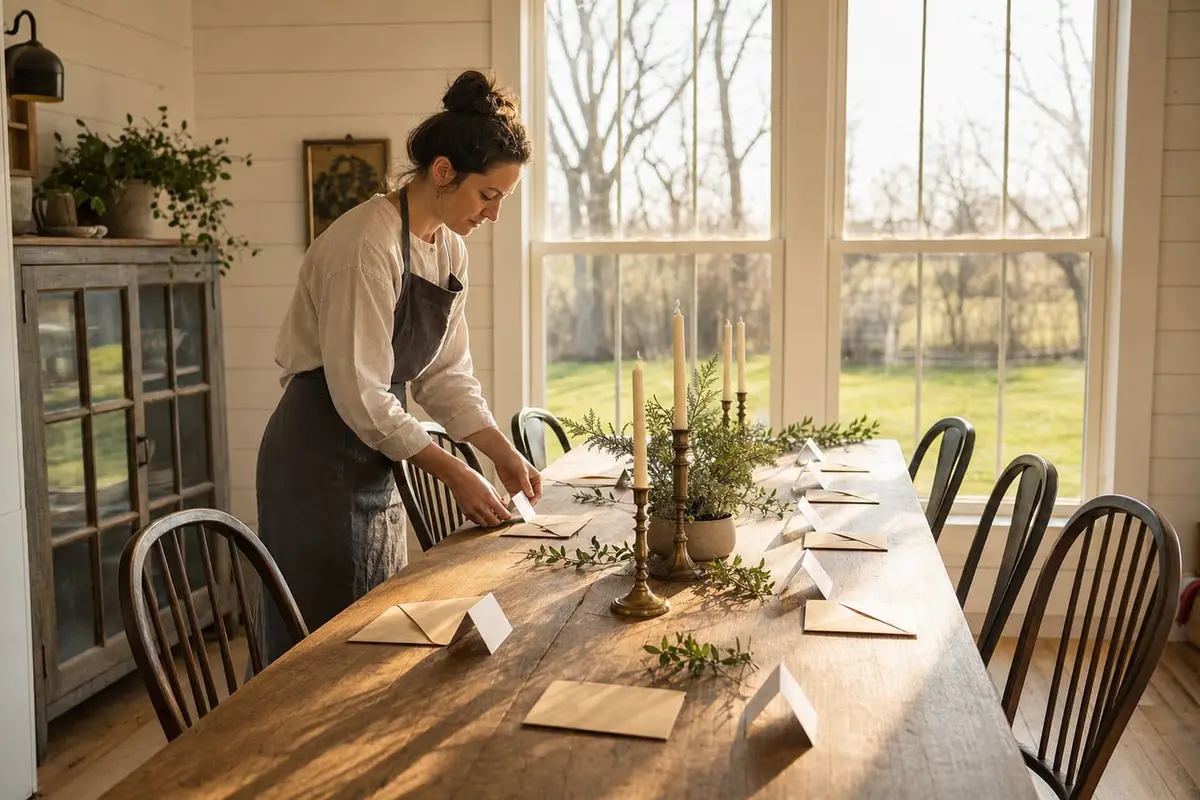
To host a murder mystery party, buy a kit built for your exact guest count, send invitations with an RSVP deadline about two weeks ahead, then send each guest a character. On the night, the host guide runs three rounds of clues and questioning, every guest votes on a culprit, and the host reads the solution aloud.
Host guide — The booklet or file in a murder mystery party kit that tells the host how to set up, when to release each round of clues and envelopes, and how to read the final solution.
We earn a commission when you buy through links on this page, at no extra cost to you. Commissions never decide which games we pick or their order. As an Amazon Associate I earn from qualifying purchases. Affiliate disclosure
The short version
Hosting a murder mystery party comes down to four decisions made in the right order: the kit, the guest list, the casting and the timeline. The kit sets everything else. It decides how many guests you need, whether a cancellation ruins the plot, whether you can play or must run the game, and how long the evening lasts. Once the kit is chosen, the rest is party planning you already know how to do: invitations, food, a bit of decor and a plan for the night.
This guide follows that order. It explains how a party game actually runs, how to match a kit to your headcount, when to send invitations and characters, what to serve, and gives an hour-by-hour timeline you can copy. It ends with the parts most first-time hosts worry about: what the host does all night, shy guests and late arrivals.
How a murder mystery party works
A murder mystery party is a game in rounds. Each guest receives a character with a backstory, secrets and a few objectives, such as finding out who borrowed the ledger or hiding where they were at nine o’clock. Nobody memorizes a script. Guests read their booklet, mingle in character and trade information.
Here is the usual arc, using Night of Mystery’s published timeline as the reference:
- Arrival and introductions (first 30 minutes). Guests receive name tags and their first-round materials. The host reads the introduction from the host guide.
- Round one. Guests work through their first objectives. In Night of Mystery games, the victim finishes their first objectives, quietly tells the host, the lights go out, and the crime happens offstage. The victim then returns as the Investigator, so nobody sits out.
- Round two. New envelopes bring plot twists, fresh clues and new objectives. Suspicion shifts.
- Round three. Final clues come out, the investigator sums up the evidence and every guest fills in an accusation sheet.
- The reveal. The host reads the solution, explaining who did it, how and why, then hands out awards such as Super Sleuth and Best Dressed.
Kits differ on one key point: who knows the culprit. In Night of Mystery games, the murderer only learns the role on opening a second envelope at the party. In Murderous Decisions games, the murderer is chosen on the night, and each suspect has a guilty and an innocent version of their story. Talking Tables kits print three alternative endings, so you can run the same box again with a different culprit. Scripted boxed games in the tradition of Decipher’s How to Host a Murder, first published in 1985, fix the culprit in advance and tell guests what to read each round.
If you are not sure a party is the right format at all, our comparison of a murder mystery game vs party sets out when a boxed case suits your group better.
Choose the kit by your guest count
Guest count is the filter that eliminates most kits. A story written for eight suspects does not work with five people, and a fixed cast cannot absorb three extra friends. Count confirmed guests first, then shop.
| Kit | Guests | How it handles your headcount | Host | Format |
|---|---|---|---|---|
| Murderous Decisions: Murder at the Pizzeria | 6 to 14, any mix | Murderer chosen on the night, so no-shows are fine | Can play | Boxed, with downloadable audio for each act |
| Broadway Murder Mysteries: Murder at the Roller Rink | 4 to 20 | 20 scripted suspects; extra guests join as detectives | Online host dashboard with videos and an invitation tool | Boxed, rated easy |
| Talking Tables: Murder on the Train | 5 to 13, ages 16+ | 12 character cards and three alternative endings | Reads the welcome speech | Boxed, reusable, with props and clues |
| Night of Mystery downloadable games | Sold in sizes from 6 to 8 up to 20+ | You buy the size you need; the killer learns the role at the party | Can play | Printable files, host guide, invitations |
A few patterns help:
- Small group (6 to 8). Almost every kit works. Pick on theme and difficulty.
- Uncertain RSVPs. Choose a flexible game. Murder at the Pizzeria is built for any combination of 6 to 14 guests, and the publisher says no character is “bolted on.”
- Big crowd (12 to 20). Look for kits that add detective roles. The listing for Murder at the Roller Rink says it includes 20 scripted suspects with flexible gender roles, rates the difficulty as easy, and lets extra guests join as detectives.
- You want to reuse it. Talking Tables’ Murder on the Train lists 12 place, name, trait and occupation cards, 28 clues, 48 accusation forms and three endings for 5 to 13 players aged 16 and up.
Our ranking of the best murder mystery party games compares more kits side by side, and how to choose a murder mystery party kit walks through difficulty, printable versus boxed, and gender-flexible casts.
Two to three weeks out: invitations and roles
Send invitations two to three weeks before the party. Night of Mystery’s host guides recommend an RSVP deadline about two weeks ahead, because the game needs a minimum number of players and you should not assign characters until you know who is coming.
Once guests confirm:
- Assign roles to fit people. Read every character description and match them to your guests. Give the most talkative friends the loud, central suspects. Give quieter guests characters with fewer lines but useful information.
- Send each guest their character. Most kits include a short description with personality notes and a costume suggestion. Keep secrets for the night: guests should arrive knowing who they are, not what they did.
- Ask for a reply. A quick “got it” from every guest saves a scramble on the day.
- Keep a cast list. Write down who plays whom, plus one or two backup assignments in case someone drops out.
For help writing roles, swapping genders or adding characters, see our guide to murder mystery party characters.
Decor and dress code, kept simple
The theme does the decorating for you. A 1980s roller rink needs a playlist and some neon; a 1930s train needs printed tickets and a few suitcases by the door. Three things matter more than props:
- Lighting you can switch off. Many kits use a lights-out moment. Know where the switch is.
- A clue station. One side table for envelopes, the evidence booklet and accusation sheets keeps the game tidy.
- Name tags. Guests forget names in character. Big, readable tags with the character name fix that.
Keep the look on the era and the setting, and skip graphic props. A theme that reads as “party” keeps the evening light.
Set a dress code that people can meet from their own closets: “1980s mall,” “black tie on a train,” “pizzeria opening night.” Mention it in the invitation and repeat it with each character’s costume suggestion. Our guide to murder mystery party costumes has outfit ideas for each era.
Food and drinks
The game style decides the menu. Wikipedia’s overview of the genre notes that scripted games are usually played over a three-course dinner, while interactive games work with finger food, a buffet or a sit-down meal.
- Mingling games: food guests can hold in one hand while reading a booklet with the other. Sliders, a taco bar, flatbread, skewers, a cheese board, cookies.
- Seated games: a simple plated dinner or a family-style pasta, served between rounds.
- Drinks: keep them simple and self-serve. Sodas, lemonade, iced tea, sparkling water and coffee with dessert.
Theme the food names if you like, but prep it ahead. The host will not have time to cook once round one starts.
Hour-by-hour plan for the night
This plan assumes a 7:00 start, a mingling game and about three hours of play. Shift the times to suit your evening.
| Time | What happens | Host to-do |
|---|---|---|
| 5:30 | Setup | Lay out name tags, envelopes in round order, clue station, playlist. Night of Mystery estimates 1 to 2 hours of setup. |
| 7:00 | Guests arrive | Hand out name tags and round-one materials. Food is out. |
| 7:30 | Introduction and round one | Read the opening from the host guide. Guests complete first objectives. |
| 8:00 | The crime | Lights out, then the investigation begins. Hand out new objectives. |
| 8:30 | Round two | Release round-two envelopes and clues. Refill food. |
| 9:00 | Round three | Final clues. The investigator or host sums up the evidence. |
| 9:30 | Accusations | Every guest fills in an accusation sheet. Collect them. |
| 10:00 | The reveal | Read the solution aloud. Hand out awards. Dessert. |
What the host actually does
The host is part game master, part stage manager. The job is pacing, not performing:
- Hold the materials. Keep round envelopes in order and the solution sealed.
- Keep time. Announce each round and give a five-minute warning before the next one.
- Answer rules questions, not plot questions. Point guests back to their booklets.
- Read the opening and the reveal. Some kits supply audio for these; Murderous Decisions posts downloadable audio tracks for each act on its website.
Can the host play too? With many modern kits, yes. Night of Mystery says its hosts can play fully without knowing the killer or the victim, as long as they skip the solution file until the end. Murderous Decisions also lists “host can play” as a feature. Fixed-script kits more often ask the host to read everything in advance and run the game.
Helping shy guests
Not everyone wants a spotlight, and most kits plan for that.
- Cast for comfort. Give quieter guests a supporting character or an investigative role, such as a reporter or a detective. These characters ask questions instead of defending themselves.
- Lean on the booklet. Scripted questions and question menus give guests something to say without improvising.
- Pair people up. Two shy friends can investigate together as partners.
- Let costumes do the work. A hat or a prop gives people a character to hide behind.
Late arrivals and no-shows
Plan for both before the night.
- Pick a flexible kit if your group is unpredictable. When the murderer is chosen on the night, as in Murderous Decisions games, an absence does not remove the culprit.
- Never give the key roles to unreliable guests. In fixed-cast kits, the culprit and the main witnesses must be there. Give these roles to people you trust to show up on time.
- Prepare a catch-up card. For a latecomer, write three lines: who they are, what has happened so far, and their current objective.
- Have a reader ready. If a minor character is missing, the host or a volunteer can read that character’s clues aloud when the time comes.
After the reveal
Hand out awards, take photos and let guests trade theories about what they missed. If you are planning a party for a milestone, our murder mystery birthday party guide covers casting the guest of honor, themes by age and cake ideas. Every guide, ranking and checklist on the subject is gathered in the murder mystery party hub.
Key facts
- Night of Mystery's host guides advise sending invitations with an RSVP deadline about two weeks before the party, then sending character sheets only to guests who confirm; the murderer does not learn the role until opening a second envelope at the party.Night of Mystery, A Knight of Murder host introduction, 2025
- Night of Mystery's sample party timeline runs arrival from 0 to 30 minutes, three rounds from 30 to 120 minutes, then a final 15 to 30 minutes for the reveal and awards; it estimates 1 to 2 hours of setup.Night of Mystery, How Does a Murder Mystery Party Work, 2026
- Murderous Decisions games play with any combination of 6 to 14 guests, and the murderer is chosen on the night, so a last-minute cancellation does not break the story.Murderous Decisions, official site, 2026
- Night of Mystery states that its games let the host play fully without knowing the killer or the victim, as long as the host skips the solution file until the party.Night of Mystery, FAQ, 2026
- Murder mystery party games typically involve 6 to 20 people; scripted versions are usually played over a three-course dinner, while interactive ones suit a mix-and-mingle buffet.Wikipedia, Murder mystery game, 2026
FAQ
How far in advance should you plan a murder mystery party?
Start about three weeks out. Buy the kit, send invitations with an RSVP deadline roughly two weeks before the party, as Night of Mystery's host guides suggest, then send character sheets to confirmed guests so they have a week or more to plan an outfit.
How long does a murder mystery party last?
Plan on about three hours. Night of Mystery's sample timeline gives 30 minutes for arrivals, three rounds over the next 90 minutes and a final 15 to 30 minutes for the reveal and awards. A sit-down dinner adds time.
Can the host play in a murder mystery party?
Often, yes. Night of Mystery and Murderous Decisions both say the host can play. Read only the setup pages and keep the solution sealed until the end. Some kits instead give the host a narrator role that is never a suspect.
What happens if a guest cancels at the last minute?
It depends on the kit. Games where the murderer is chosen on the night, such as Murderous Decisions titles, keep working with any 6 to 14 guests. Fixed-cast kits need someone to read the missing role, so check the host guide before you buy.
What food should you serve at a murder mystery party?
Food guests can eat standing up works best, since people move around to question each other. A buffet, sliders or a taco bar suits mingling games; a plated dinner suits scripted games played at the table. Keep drinks simple: sodas, lemonade, iced tea and sparkling water.