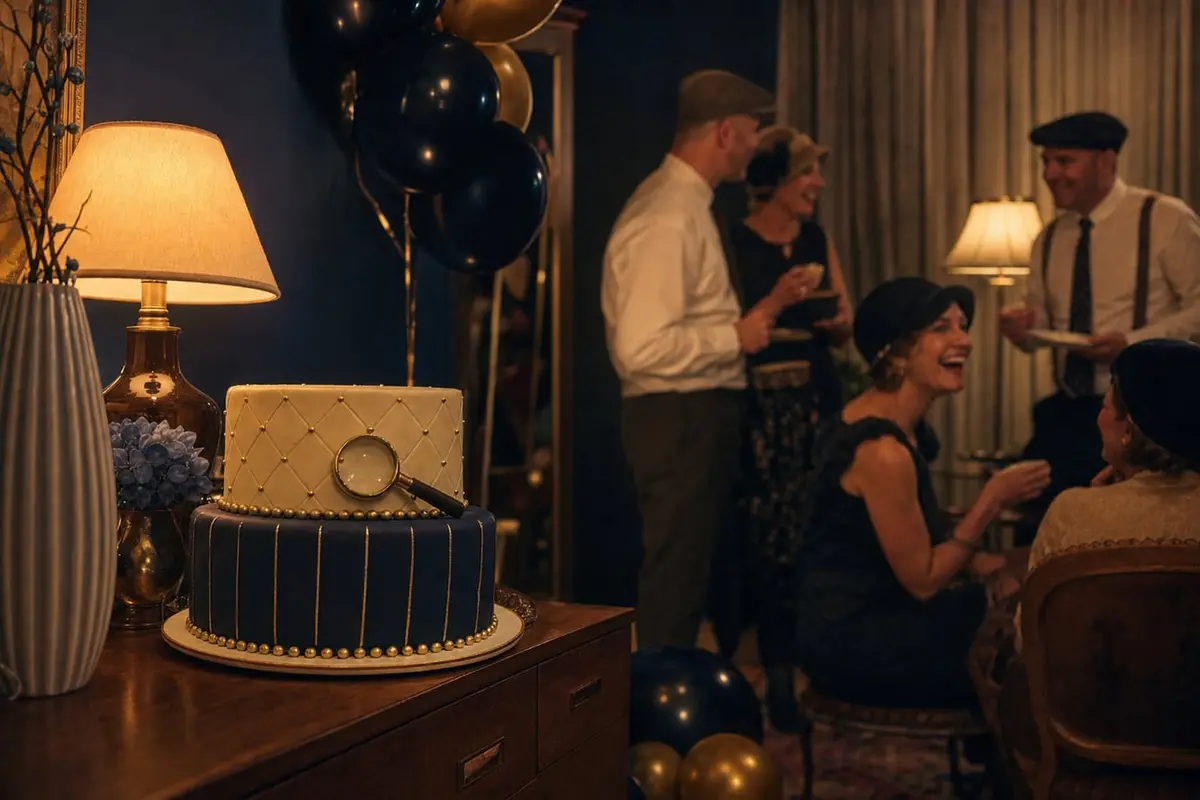
For a murder mystery birthday party, pick a kit sized to your confirmed guest list, cast the birthday person in a central role that stays in play all night, and match the theme to their favorite decade, such as an 80s prom for a 40th. For ages 13 to 17, Night of Mystery sells teen editions of its party games.
Clean version — An edition of a murder mystery party game with the adult references removed, which some publishers sell alongside the standard edition for teens, family groups and workplaces.
We earn a commission when you buy through links on this page, at no extra cost to you. Commissions never decide which games we pick or their order. As an Amazon Associate I earn from qualifying purchases. Affiliate disclosure
The short version
A murder mystery turns a birthday into an evening where every guest has a part to play, and the person you are celebrating can be at the center of the story without giving a speech. It works for a 30th, a 40th, a 50th or a teen birthday, as long as three choices are right: a kit that fits your exact guest count, a role that keeps the birthday person in the game, and a theme that suits their age and taste.
This guide covers those three choices first, then theme ideas by milestone, how to adapt the game for teens, how to keep the budget in check, cake and decor that stay on theme without anything graphic, and where the birthday moments fit in the timeline. For the full hosting playbook, with invitations, roles and an hour-by-hour plan, read how to host a murder mystery party.
Why the format suits a birthday
At most birthday parties, guests split into the groups they already know. A murder mystery breaks that up. Each guest receives a character with secrets and objectives, and the objectives push them to talk to people they would not normally seek out. Coworkers, college friends and cousins end up questioning each other within twenty minutes.
The structure also gives the evening a shape. Party kits run in rounds: new clues arrive, suspicion shifts, and everyone votes on the culprit before the solution is read aloud. That arc gives you natural moments for cake, a toast and gifts. And the photos are better than at a standard party, because everyone is in costume.
Cast the birthday person well
The guest of honor’s role matters more than any decor. Four options, with their trade-offs:
- The lead suspect. The best default. Lead suspects carry the biggest secrets and draw the most questions, so the birthday person is talked about all night. Ask the host guide which characters are central and give them one.
- The detective or investigator. Ideal for someone who loves puzzles more than performing. Investigative roles question others and pull the evidence together at the end. In Night of Mystery games, the victim returns as the Investigator after the crime, so read the host guide before you cast.
- The culprit. Only for a birthday person who enjoys bluffing, and only if the kit lets you choose. In Murderous Decisions games the murderer is chosen on the night, and in Night of Mystery games the killer learns the role from a second envelope at the party, so neither lets you guarantee it.
- Not the victim, unless the role comes back. A victim who leaves the story early sits out their own party. Check what the victim does after the crime.
Should the birthday person know the plot? Usually not. Most kits let one host run the game while playing, so a friend or partner can organize everything and keep the solution sealed. If the birthday person is hosting their own party, choose a kit where the host can play without reading the solution. Our guide to murder mystery party characters explains how to read character lists and assign roles.
Invitations that double as birthday invites
Send invitations two to three weeks ahead, with an RSVP date about two weeks before the party. The headcount decides which kit size you buy and which characters you hand out, so a firm list matters more than at an ordinary birthday.
Make the invitation do two jobs. Up top, the usual details: whose birthday, the date, the time and the address. Below, the game: the setting, the dress code and a line telling guests they will receive a character to play. Once guests confirm, send each one their character description and costume suggestion, and keep the guest of honor’s role a surprise for everyone else. If the party is a surprise, route all RSVPs to the organizer rather than the birthday person.
Theme ideas by milestone
Pick a theme the birthday person will enjoy dressing up for. A decade they grew up in is the easy win, because guests already know the music and the clothes.
| Birthday | Theme idea | Example kit and what it offers |
|---|---|---|
| 13 to 17 | Prom, fairy tales, villains, circus | Night of Mystery teen editions, designed for ages 13 to 17 |
| 30th | Y2K and early 2000s | Night of Mystery’s Y2K Chaos, a downloadable game sold by guest count |
| 40th | 1980s prom or mall | Night of Mystery’s Totally Rad 80s Prom Gone Bad; Broadway Murder Mysteries’ 80s Mall Murder Madness, listed for 4 to 20 players, adults and teens |
| 50th | 1970s disco | Talking Tables’ 1970s murder mystery kit, listed for 5 to 13 players aged 16+, with alternative endings |
| 60th and up | 1920s gala, 1930s train, country manor | Talking Tables’ Murder on the Train; Murderous Decisions’ Murder at the Manor |
Those pairings are a starting point, not a rule. A 50th can be a pirate night if that is what the birthday person wants. The Broadway Murder Mysteries listing rates its game as easy and says it suits a party “where the clues come second to costumes,” which makes it a good fit when the group cares more about the 80s outfits than the deduction. Our ranking of the best murder mystery party games compares more kits on player count, difficulty and format.
Adapt the game to the age group
Adult milestones (30, 40, 50 and up). The main variable is difficulty. A group of friends who play board games will enjoy a kit with real clues to connect. A mixed crowd of family, neighbors and coworkers will have more fun with an easy, social game. Check the guest range too: a 50th with 25 guests needs a kit that scales, such as a downloadable game sold for 20+ guests or a boxed kit that adds detectives.
Teen birthdays (13 and up). Use a kit written for teens. Night of Mystery sells teen editions of its games, designed for ages 13 to 17, and offers clean versions without adult references that it says teens and conservative groups often choose. The idea is not new: Decipher’s How to Host a Murder line, which started in 1985, later added a How To Host A Teen Mystery series. Read the age on any boxed kit before buying, since many adult kits are listed for 16 or 18 and up.
A few teen-specific tips:
- Let an adult host, or co-host with the birthday teen, so the teen can play.
- Keep rounds short. Three rounds of about 30 minutes hold attention better than a long scripted dinner.
- Swap the dinner for pizza and snacks guests can eat while moving around.
- Make it a sleepover finale. The reveal works well as the last activity before movies.
Keep the budget in check
You can spend a lot or very little on a murder mystery party. The kit is a one-time cost; the rest scales with your choices.
- Downloadable versus boxed. Printable kits from publishers such as Night of Mystery are sold by guest count and you print what you need. Boxed kits arrive ready to play, and some, like the Talking Tables kits with alternative endings, can be played again with a different group.
- Costumes from closets. Set a dress code guests can meet with what they own. Our murder mystery party costumes guide lists easy outfits by era.
- Potluck by character. Ask each guest to bring a dish that their character would serve. It fits the game and spreads the cost.
- Print the decor. Many kits include printable signs, menus and place cards. Add a playlist and the room is set.
Cake and decor without anything graphic
Theme the party on the era and the mystery, not the crime. That keeps photos shareable, works for every age, and suits family guests.
Cake ideas:
- A sheet cake decorated as a case file, with “Case Closed” piped across it after the reveal.
- A fingerprint pattern or a magnifying glass in fondant.
- Cupcakes topped with each suspect’s name on a little flag.
- An era cake: a disco ball for a 1970s party, a vinyl record for the 80s, a train ticket for a railway mystery.
Decor ideas:
- A “suspects board” with each guest’s character name and photo, filled in as people arrive.
- Era lighting: string lights for a gala, neon colors for the 80s.
- An evidence table with envelopes and accusation sheets.
- A photo corner with props that fit the setting, such as hats, sunglasses and a magnifying glass.
Leave out body outlines, fake injuries and prop weapons, even if the kit shop sells them. They add little to the game and change the mood.
Fit the birthday moments into the timeline
A murder mystery party runs about three hours. Night of Mystery’s sample timeline gives 30 minutes for arrivals, three rounds over the next 90 minutes and a final 15 to 30 minutes for the reveal and awards. The birthday moments slot in like this:
| Time | Game | Birthday moment |
|---|---|---|
| 7:00 | Arrivals, name tags, first materials | Greet the guest of honor in character |
| 7:30 | Introduction and round one | |
| 8:15 | Round two | Short break: toast to the birthday person with sodas or lemonade |
| 9:00 | Round three and accusations | |
| 9:45 | The reveal and awards | Add a “Birthday Star” award to the kit’s Super Sleuth and Best Dressed |
| 10:00 | Game over | Candles, cake and gifts |
Cake goes after the reveal. Bringing it out mid-game stalls the story and invites theories over dessert instead of answers.
Gifts and the gift exchange
Guests often ask what to bring. Two ideas that fit the theme:
- A mystery to take home. Friends can pool for a boxed murder mystery game the birthday person can play later with a partner or a small group. Our comparison of a murder mystery game vs party explains how a boxed case differs from the party you just played.
- A gift exchange. For a big group, a white elephant swap after the cake keeps the fun going and keeps gifts low-key. Set a price limit in the invitation.
For more planning help, the murder mystery party hub gathers every guide and ranking on the subject, including how to choose a murder mystery party kit.
Key facts
- Night of Mystery says its teen murder mystery party games are designed for ages 13 to 17 and presents them for teen birthday parties, sleepovers and group hangouts; its teen collection lists nine titles.Night of Mystery, Teen Murder Mystery Party Games, 2026
- Night of Mystery's Totally Rad 80s Prom Gone Bad is sold in sizes for 6 to 8, 8 to 12, 10 to 15, 15 to 20 and 20+ guests, in adult, adult clean, LGBTQ and teen editions; the publisher says teens often use the clean versions.Night of Mystery, Totally Rad 80s Prom Gone Bad product page, 2026
- Murderous Decisions games play with any combination of 6 to 14 guests, choose the murderer on the night, and can be expanded with additional characters for larger groups.Murderous Decisions, official site, 2026
- Decipher's How to Host a Murder series began with The Watersdown Affair in 1985 and later added three How To Host A Teen Mystery titles.Wikipedia, How to Host a Murder, 2026
- Night of Mystery's sample party timeline runs arrival from 0 to 30 minutes, three rounds from 30 to 120 minutes, then a final 15 to 30 minutes for the reveal and awards such as Super Sleuth and Best Dressed.Night of Mystery, How Does a Murder Mystery Party Work, 2026
FAQ
Who should the birthday person play at a murder mystery party?
A central character who stays in the game all night: a lead suspect with juicy secrets, or the detective if they love solving. Avoid a role that leaves the story early, and only make them the culprit if they enjoy bluffing and the kit lets you choose.
Is a murder mystery party a good idea for a teenager's birthday?
Yes, with a kit made for teens. Night of Mystery sells teen editions designed for ages 13 to 17, and many publishers offer clean versions without adult references. Check the age printed on boxed kits: several, such as Talking Tables, list 16 and up.
How many guests do you need for a murder mystery birthday party?
Most kits start at six to eight guests. Flexible games stretch further: Murderous Decisions plays with any 6 to 14 guests, and some boxed kits list 4 to 20 players with extra guests joining as detectives. Count confirmed RSVPs before you buy.
What kind of cake goes with a murder mystery party?
A cake that matches the story's era or setting, not the crime. Think a case-file sheet cake with a magnifying glass, a fingerprint pattern, a train ticket for a railway mystery or a disco ball for a 1970s theme. Leave out anything that looks like a weapon.