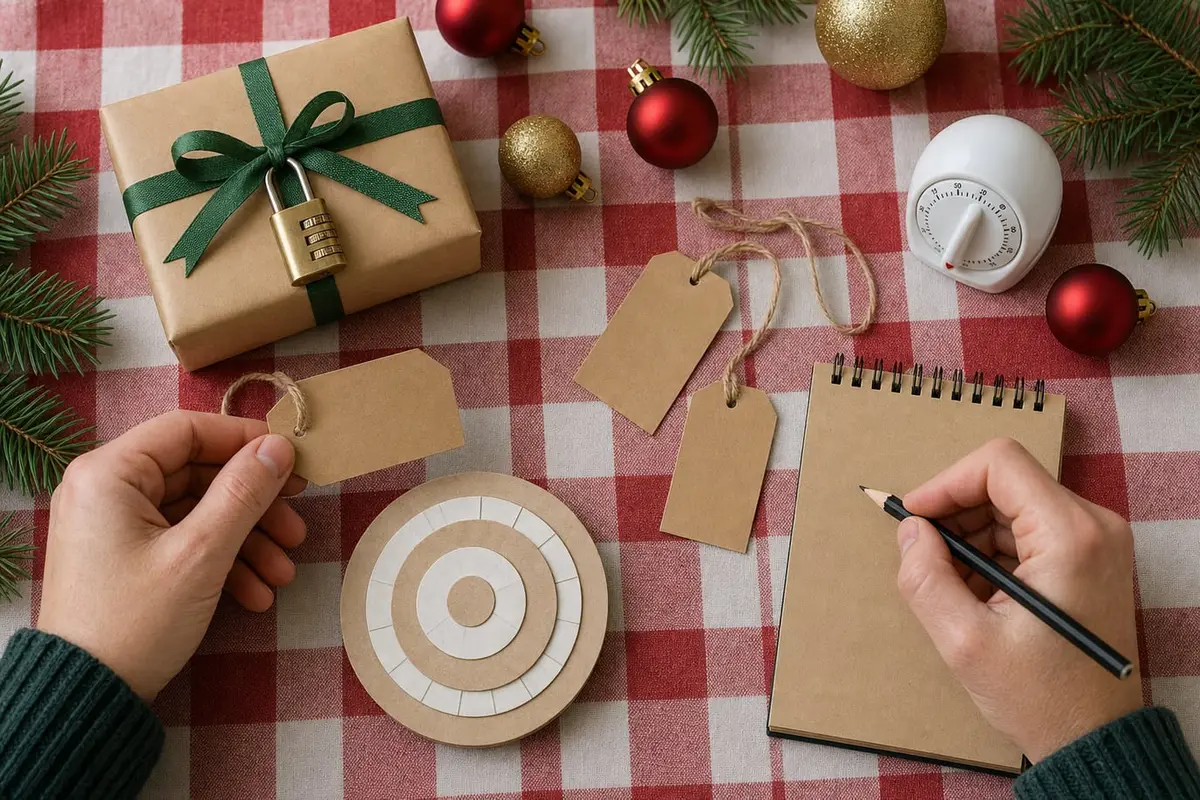
A Christmas escape room at home takes three forms: a boxed game played in one sitting, such as Talking Tables' Santa edition (10 puzzles, about 45 minutes, ages 8 and up); an advent calendar with a daily puzzle, such as EXIT's The Magic of Christmas; or a homemade room built from gift tags, ornaments and a padlocked present.
Christmas escape room — A holiday-themed escape room game played at home: a chain of puzzles whose answers open locks, cards or doors until the group completes a festive story, either in one sitting from a box, one door a day from an advent calendar, or from puzzles the host builds.
We earn a commission when you buy through links on this page, at no extra cost to you. Commissions never decide which games we pick or their order. As an Amazon Associate I earn from qualifying purchases. Affiliate disclosure
What a Christmas escape room at home is
A Christmas escape room is an escape room game with a holiday story: the group solves a chain of puzzles to open locks, cards or doors until Santa’s sleigh flies, the stolen star is back on the tree or the last present is found. This page is about playing at home. If you want a themed room at a local venue, search for escape rooms near you; the advice below covers what you can set up on your own table.
At home there are three ways to do it, and they suit different families.
| Way to play | Time | Players | Preparation | Example |
|---|---|---|---|---|
| Boxed game, one evening | About 45 to 60 minutes | 2 to 6 | Open the box | Talking Tables’ Christmas Escape Room, Santa Edition |
| Advent calendar, one door a day | 5 to 15 minutes a day, December 1 to 24 | 1 to 4 | None | EXIT: The Magic of Christmas, The Christmas Key |
| Homemade room | 30 to 60 minutes | Any, in teams | An evening or two of building | Your own story and props |
A boxed Christmas escape room for one evening
A boxed game is the fastest route: everything is printed, the puzzles are tested and the solution is in the box.
Talking Tables makes a small festive one. In its Christmas Escape Room, Santa Edition, Santa’s sleigh has broken down on Christmas Eve, and players help him gather presents scattered across a snowy mountain and solve clues left by the elves before sunrise. The publisher gives 10 games to solve within 45 minutes and rates it for ages 8 and up. A later version lists 2 to 6 players and contains 10 puzzles built on letters, lists and wrapped gifts, a set of props, an introduction, a notepad and instructions.
It is a short, gentle game, which is exactly what a family table on Christmas Eve needs. Groups of puzzle fans will want something harder: any standard escape room box can become a Christmas game with a festive table around it. Our ranking of the best escape room games lists the boxes worth playing, and our guide to the escape room in a box explains how the formats differ.
A puzzle a day: Christmas escape room advent calendars
An advent calendar turns the escape room into a December ritual: one door, one puzzle, a few minutes after dinner.
EXIT’s Advent Calendar: The Magic of Christmas opens with a hiker who wakes up in an enchanted, snow-covered forest with red baubles in the trees and green fur on their hands. Designed by Emely, Inka and Markus Brand, it plays with one or more players at 5 to 10 minutes a day over 24 days. Solving one day’s riddle tells you which door to open next, a hint booklet is included, and the box shows a difficulty of 2 out of 5. In his October 2026 review, Dale Yu found most puzzles on the easier side, with one very hard and three or four moderately hard.
For a screen-free family book, The Christmas Key by Naya Publishing gives one puzzle a day from December 1 to 24 to find out who took the Christmas Key.
Our comparison of the best escape room advent calendars ranks the calendars by difficulty, group and the time each door takes.
Build your own Christmas escape room
A homemade room costs little and can be tuned to the youngest player. The method is the same as for any escape room, and our DIY escape room guide walks through it step by step. Here is how to give it a Christmas skin.
1. A one-line story and a clear goal. “The Grinch has locked away the star for the top of the tree. Find the code before the lights go out.” The goal is a physical object the players can hold at the end.
2. Four to six puzzles in a chain. Each answer opens the next step, and the last one opens a padlocked box. Build the chain backward from the final lock, so every clue has a home.
3. Christmas props as puzzles. Holiday objects hide clues naturally:
| Prop | Puzzle family | How it works |
|---|---|---|
| Gift tags on wrapped presents | Hidden objects, ordering | Each tag carries one letter; the order of the presents by size spells the word |
| Ornaments on the tree | Counting, colors | The number of red, gold and green baubles gives a three-digit code |
| A carol sheet | Word code | The first letter of selected lines spells the next hiding place |
| A cookie tin | Hidden objects | The next clue sits under the paper liner |
| A string of lights | Patterns | Unlit bulbs mark the positions of the digits to keep |
| A padlocked present | Final lock | The last code opens the box with the star or the treat inside |
Searching for hidden objects is the most common puzzle in real escape rooms: Scott Nicholson’s 2015 survey of 224 rooms found it in 78% of them, ahead of team communication (58%) and counting (53%). A tree, a pile of presents and a kitchen full of tins give you plenty of hiding places. For more puzzle types and how players attack them, see our guide to escape room puzzles.
4. Test it on one person. Ask someone who did not build it to play the chain once. Every puzzle that stalls them for more than five minutes needs a clearer clue.
5. Prepare hints in three levels. A nudge, a stronger hint, then the answer. Write them on cards before the game so you can give them without thinking.
We do not publish ready-to-print puzzles: a room built around your own tree and your own family is more fun to solve than a generic printout.
What you need for a homemade Christmas escape room
Most of the materials are already in the house in December. A short shopping list covers the rest.
- One lockable box. A small toolbox, a cash box or a gift box with a hasp. It holds the reward and the final answer.
- One or two padlocks. A three- or four-digit combination lock is enough for a family game; a word lock adds variety. Set the codes before you hide the clues.
- Envelopes and gift tags. Number the envelopes on the back with a small dot pattern rather than digits, so players have to find the order.
- Wrapping paper, ribbon and ornaments. These are your hiding places and your counting puzzles.
- A notepad and two pencils. One for the team’s codes, one for crossing off solved clues.
- A timer. A kitchen timer or a phone placed face down on the table.
- A small reward. A box of cookies, a family photo printed and wrapped, or the star for the top of the tree.
Avoid anything fragile in the hiding places, and keep candles away from the play area: players will be rummaging under the tree and through wrapping paper with their eyes on the clues, not on the flame.
Keep it fair
The most common mistake in a homemade room is a clue that only makes sense to the person who wrote it. Each puzzle should produce one clear answer, such as a number, a word or an object, and the players should always know which lock it opens. If two puzzles could open the same lock, number the locks or color-code them with ribbon. Our DIY escape room guide explains how to build the chain backward so that every clue has a home.
Choose by age and group
- Children around 8 and up with parents. A short boxed game, such as the Santa edition, or a homemade room of three puzzles with one padlock. Keep reading to a minimum and let the children handle the props.
- Teens and adults together. An advent calendar played after dinner each night, or a standard escape room box on Christmas Eve. Teens enjoy being the code-breakers; give them the notebook.
- Adults who like a challenge. A harder standard box on a quiet evening. Our guide to easy vs hard escape room games explains how to read difficulty ratings.
- A big family gathering. Build one homemade room and split into two teams with identical copies of the puzzles, then race to the padlocked present.
Running the hour
- Set the scene. Dim the main light, switch on the tree and read the story aloud.
- Start a timer. Forty-five minutes is a good target for a family game.
- One notebook, one reader. One person writes down codes and unused objects, another reads each clue aloud. Our escape room tips cover team roles and when to take a hint.
- Hints on request. Offer a nudge after five minutes of silence, not before.
- Celebrate the last lock. Open the present together; a plate of cookies inside is the best reward.
Christmas escape room or Christmas murder mystery?
Both are December favorites. An escape room is cooperative: everyone works together against the puzzles, which makes it ideal with children and quiet guests. A murder mystery is social: each guest plays a suspect and the group accuses a culprit. If your party wants to play roles, see our picks for a Christmas murder mystery game, sorted by group size, time and age. The escape rooms at home hub gathers every guide to playing the rest of the year.
Key facts
- Talking Tables' Christmas Escape Room, Santa Edition has players help Santa gather presents and solve clues left by the elves before sunrise, with 10 games to be solved within 45 minutes, for ages 8 and up.Talking Tables trade page, Christmas Escape Room: Santa Edition, 2026
- Talking Tables lists the second version of its Santa edition for 2 to 6 players aged 8 and up, with 10 puzzles built on letters, lists and wrapped gifts, a set of props, an introduction, a notepad and instructions, and around 45 minutes of play.Talking Tables trade page, Christmas Escape Room: Santa Edition (v2), 2026
- EXIT: The Game Advent Calendar, The Magic of Christmas is designed by Emely, Inka and Markus Brand for 1 or more players at 5 to 10 minutes a day over 24 days; solving one day's riddle tells you which door to open next, a hint booklet is included and the box shows a difficulty of 2 out of 5.Dale Yu, The Opinionated Gamers, review of The Magic of Christmas, 2026
- Across 224 rooms described by 175 escape room facilities, the most common puzzle types were searching for hidden physical objects (78%), team communication (58%), light such as blacklight (54%) and counting (53%).Scott Nicholson, Peeking Behind the Locked Door: A Survey of Escape Room Facilities, 2015
FAQ
How do you make a Christmas escape room at home?
Write a one-line holiday story with a clear goal, such as finding the key to Santa's sack, then build four to six puzzles backward from the final lock. Hide the clues in gift tags, ornaments, cookie tins and a carol sheet, test the chain on one person and keep three levels of hints ready.
What is a good Christmas escape room for kids?
A short boxed game with a gentle story. Talking Tables' Santa edition asks players to help Santa deliver presents before sunrise, with 10 puzzles in about 45 minutes, and the publisher rates it for ages 8 and up. For younger children, keep a homemade room to three puzzles and one padlock.
How long does a Christmas escape room take?
A boxed game is played in one sitting: Talking Tables gives about 45 minutes for its Santa edition. An advent calendar spreads the story over December, with 5 to 10 minutes a day for EXIT's The Magic of Christmas. A homemade room lasts as long as you build it, usually 30 to 60 minutes.
Can adults play a Christmas escape room?
Yes. EXIT's The Magic of Christmas plays with one or more players at 5 to 10 minutes a day, and its box shows a difficulty of 2 out of 5, so it suits adults who want a light daily puzzle. For an adult group on one evening, a standard EXIT or Unlock! box works with a festive table around it.
How many players does a Christmas escape room need?
Two to six is the comfortable range. Talking Tables lists its Santa edition for 2 to 6 players, while advent calendars work for one person or a couple at the kitchen table. For a bigger family, split into two teams with copies of the same homemade puzzles and race.
What is the difference between a Christmas escape room and a Christmas murder mystery?
An escape room is cooperative: the whole group solves puzzles together to finish a story. A murder mystery is social: guests play suspects, question each other and accuse a culprit. Pick the escape room for children and puzzle fans, the mystery for a party that likes to play a role.
Sources
- Talking Tables: Christmas Escape Room, Santa Edition (trade page)
- Talking Tables: Christmas Escape Room, Santa Edition, second version (trade page)
- The Opinionated Gamers: Dale Yu, EXIT Advent Calendar, The Magic of Christmas (October 1, 2026)
- Scott Nicholson: Peeking Behind the Locked Door, A Survey of Escape Room Facilities (2015, PDF)
Keep investigating
- DIY Escape Room: How to Make an Escape Room at Home
- Best Escape Room Advent Calendars: One Puzzle a Day Until Christmas
- Escape Room Puzzles: The 7 Types and How to Solve Each One
- Christmas Murder Mystery Games: Picks by Group Size and How to Host
- Escape Room Tips: How to Win an At-Home Escape Room Game
- Escape Room Games to Play at Home