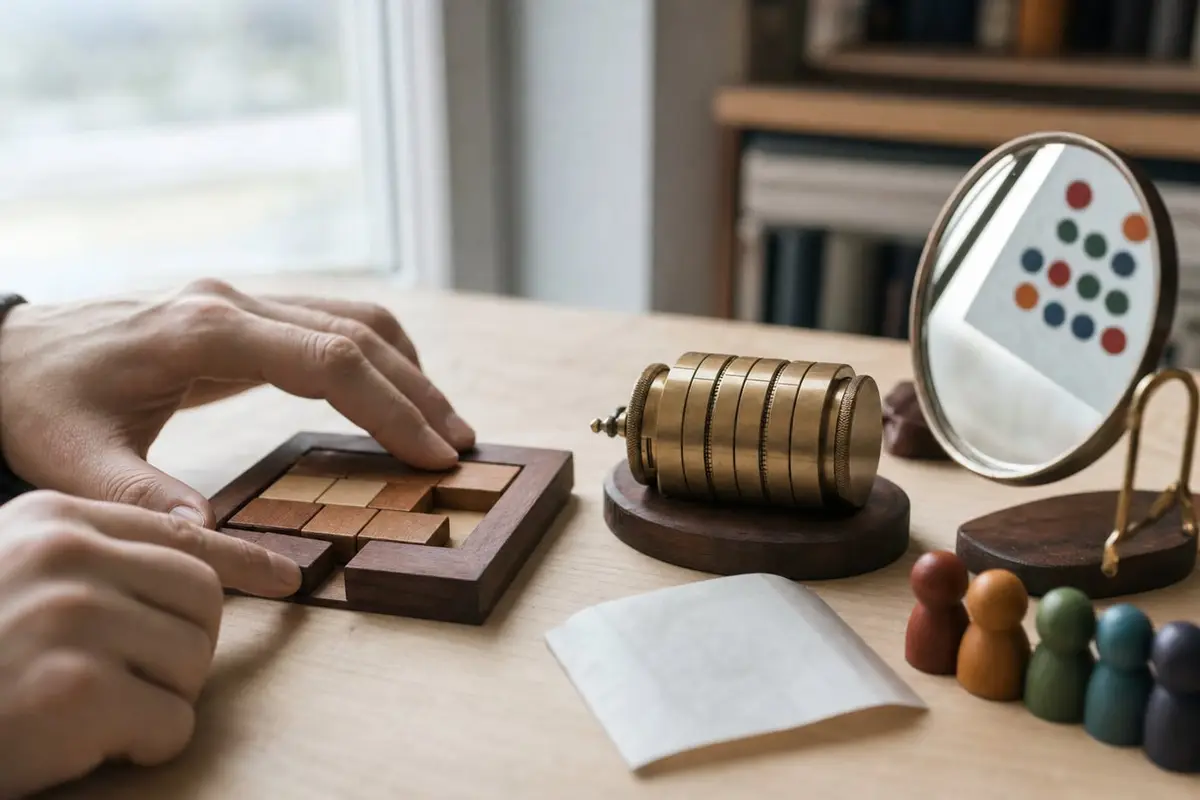
Escape room puzzles fall into seven families: codes and ciphers, locks and combinations, hidden objects, logic and math, patterns and counting, physical manipulation, and meta-puzzles. In Scott Nicholson's 2015 survey of escape rooms, searching for hidden objects was the most common type (78% of rooms), ahead of team communication (58%), light (54%) and counting (53%).
Escape room puzzle — A challenge inside an escape room game whose answer, usually a number, word, direction, object or place, opens a lock, reveals a new card or feeds a final puzzle, and which can normally be solved with information found inside the game.
We earn a commission when you buy through links on this page, at no extra cost to you. Commissions never decide which games we pick or their order. As an Amazon Associate I earn from qualifying purchases. Affiliate disclosure
The seven families at a glance
Every escape room puzzle, in a venue or in a box, ends in something the game can check: a number, a word, a direction, an object or a place. What changes is how you get there. Sorting puzzles into families is the fastest way to stop staring at a card and start working on it, because each family has its own tell and its own method.
| Family | What it asks of you | How to recognize it | How to attack it | Where boxed games use it |
|---|---|---|---|---|
| Codes and ciphers | Translate symbols into letters or numbers | Rows of symbols, a legend, a wheel or a book of signs | Find the key first, then decode a short piece to confirm | EXIT riddles that end in a three-digit code; Unlock! codes typed into the app |
| Locks and combinations | Turn a result into the exact input a lock accepts | A lock symbol, a number of digits, a keypad | Count digits, match the symbol, check the order | EXIT’s decoder disk with 10 symbols; Deckscape’s three-digit toolbox |
| Hidden objects | Notice what is in plain sight | Card art crowded with detail; a story that mentions an item twice | Scan every revealed card slowly, in good light | Unlock!‘s hidden numbers and letters; EXIT cards found in book illustrations |
| Logic and math | Reason from rules to a single answer | Symbols such as + or ÷, constraints, a grid | Write the rules down and eliminate options | Deckscape’s demo, where screws marked with math symbols give the code |
| Patterns and counting | Find the rule linking several items | Repeated shapes, colors or quantities | Line items up side by side; count everything twice | Unlock!‘s red and blue cards combined by adding their numbers |
| Physical manipulation | Handle, fold, align or assemble an object | Odd components, cut lines, pieces that look incomplete | Check the rules on what you may alter, then try it | EXIT, which lets you write on, fold or cut its materials |
| Meta-puzzles | Combine several earlier answers | A final lock or card that needs more than one input | Keep every solved answer in one place | Mattel’s Werewolf Experiment: 19 puzzles feeding three locks |
Two cross-cutting skills sit on top of the seven families. Team communication puzzles, where one player holds half of the information, appeared in 58% of the rooms Nicholson’s survey described. Light puzzles, often with a blacklight, appeared in 54%. Both turn up inside other families more than as families of their own.
What the research says about puzzle types
The best public data on puzzle types comes from Scott Nicholson’s Peeking Behind the Locked Door, a 2015 survey of escape room facilities. Of 404 facilities contacted, 175 answered at least part of it, and owners described 224 rooms. The paper notes that puzzle types were the most sensitive topic for owners, who want to protect their content, so the figures show how often a type appears, not how hard it is.
| Puzzle type in the survey | Share of rooms |
|---|---|
| Searching for physical objects hidden in the room | 78% |
| Team communication | 58% |
| Light | 54% |
| Counting | 53% |
| Noticing something “obvious” in the room | 49% |
| Symbol substitution with a key | 47% |
| Using something in an unusual way | 47% |
| Searching for objects in images | 43% |
| Assembly of a physical object, such as a jigsaw | 40% |
| Algebra and other mathematics | 39% |
| Pattern identification | 38% |
| Riddles | 37% |
| Ciphers without a key | 35% |
| Abstract logic, such as Sudoku | 22% |
| Knowledge of facts not provided in the room | 11% |
Nicholson also found regional habits: Asian rooms leaned on counting (62%), rooms in the Americas on assembling a physical puzzle (58%), and European rooms on searching for objects in images (56%).
These are venue figures. A boxed game cannot hide a key under a rug, so it moves the same families onto paper: the search becomes a detail in card art, the padlock becomes a decoder disk or an app, and the jigsaw becomes a card you fold or cut.
How to spot and attack each family
Codes and ciphers
A cipher with a key (a legend, a wheel, a page of symbols) is a lookup job; one without a key is a deduction job. Nicholson found the first kind in 47% of rooms and the second in 35%. Attack: find the key before decoding anything, then translate two or three symbols and check that they make sense. Room Escape Artist’s glossary defines the Caesar cipher as a fixed shift of every letter along the alphabet. If the decoded text is nonsense, you probably have the wrong key or the wrong reading direction.
Locks and combinations
The lock tells you what the answer looks like before you solve anything. In EXIT, every locked door or object carries one of 10 symbols and opens with a three-digit code entered under that symbol on the decoder disk. Attack: note the digit count and the symbol, then look for a puzzle that yields exactly that. When a code fails, EXIT’s manual says to check the symbol and the order of the digits before rethinking the riddle. Room Escape Artist calls the link between puzzles and locks “lock mapping”: when it is poor, players try one code in several locks and lose momentum.
Hidden objects
The single most common type in venues, and the easiest to miss on a card. The Unlock! leaflet warns that objects are not always obvious and that hidden letters or numbers on cards match cards in the deck; its app even has a button that points to the closest hidden object. EXIT adds riddle cards whenever one appears in a book illustration. Attack: pass every revealed card around the table and read the art, not just the text.
Logic and math
These puzzles state rules and expect one answer. In the Deckscape demo round published by dV Giochi, a toolbox code comes from screws marked with math symbols: each column of digits gives one number of the code. Attack: write the constraints down, test the simplest reading first, and use a grid when several items must be matched to several slots, the same way a deduction game is solved.
Patterns and counting
Here the answer hides in a relationship: how many, which color, which shape repeats. Room Escape Artist even names the “zero counting puzzle,” where some of the counted items do not exist and the right digit is zero. In Unlock!, a blue card combines with a red card by adding their numbers; if the sum matches a card in the deck, you reveal it. Attack: sort cards by color or shape, then count twice, with two different people.
Physical manipulation
Assembling, folding, aligning and using an object in an unusual way. In single-use games this is where the box surprises you: the EXIT manual says you may write on, fold or cut the materials, and that it is sometimes required. Meeple Mountain singles out a puzzle in EXIT: The House of Riddles that uses your body and the physical space where you play. Attack: check what the rules allow, then try the obvious physical action. In reusable games such as Unlock! Escape Adventures, components are never altered, so the manipulation happens in the app or in your head.
Meta-puzzles
A meta-puzzle needs the results of several earlier ones. Nicholson found that 45% of the games described were path-based, with several puzzle paths feeding a meta-puzzle, against 37% sequential and 13% open. In a box, Mattel’s Escape Room in a Box: The Werewolf Experiment funnels 19 puzzles into the codes of three locks, according to ICv2. Attack: keep every solved answer written in one place, even after its lock opens.
Red herrings and outside knowledge
Room Escape Artist defines a red herring as an item or piece of information that contributes to no solution but can make players waste time, intentional or not. Nicholson’s overview of how a room plays out lists it among the possible results of a solved puzzle, alongside a code, a key or a piece of a meta-puzzle. Good boxed games keep them rare: EXIT’s manual says every code can be solved logically.
Outside knowledge is rarer still. Only 11% of the rooms in Nicholson’s survey needed facts not provided in the room. If a puzzle seems to call for trivia, you have more likely missed a legend, a card or a hidden detail.
How puzzles are chained
Knowing the structure tells you whether to split up or stay together.
- Sequential (linear): one puzzle opens the next. Meeple Mountain describes the beginner EXIT titles this way: you get only the riddle cards and book pages you need for the current puzzle.
- Path-based: several chains run at once and meet in a meta-puzzle. Deckscape’s demo splits cards into colored decks and says you can work on them simultaneously or together.
- Open: many puzzles are available from the start. Meeple Mountain notes that harder EXIT titles drop the sequence and hand you the whole book, so part of the challenge is working out which information belongs together.
Which series leans on which family
| Series | How answers are checked | Families it leans on | Reusable |
|---|---|---|---|
| EXIT (Kosmos / Thames & Kosmos) | Three-digit codes on a decoder disk, confirmed by answer cards | Codes, locks, physical manipulation, hidden details in the book | No, materials are cut and folded |
| Unlock! (Space Cowboys) | Card numbers, codes and machines in a free app | Hidden objects, combinations, machines | Yes, nothing is altered |
| Deckscape (dV Giochi), such as The Mystery of Eldorado | Answer printed on the back of each card | Logic, math, visual patterns (as in the official demo round) | Yes, cards go back in order |
Meople’s Magazine sums up EXIT as low tech and low structure: everything in its booklet is public from the start, and the code dial tells you which card to check. For a full comparison of these formats, see how an escape room in a box works.
Playing a puzzle vs making one
This guide is about recognizing and solving puzzles in a game someone else designed. If you are looking for escape room puzzle ideas to build your own room, the DIY escape room guide covers which puzzle types produce a clear answer, how to build the chain backward and how to write three-level hints. For table habits that apply to every family (one shared page of notes, everything in view, a hint rule agreed in advance), read our escape room tips.
Where to go next
If you can name the families, you can judge difficulty from a box’s description: a game heavy on open structures and ciphers without a key will be harder than a linear one built on search and counting. Our guide to easy vs hard escape room games explains how publishers rate difficulty, and the best escape room board games compares the series side by side. Every guide on the subject is in the Escape Rooms at Home hub.
Key facts
- Across the 224 rooms described by 175 escape room facilities, the most common puzzle types were searching for physical objects hidden in the room (78%), team communication (58%), light such as blacklight (54%), counting (53%), noticing something obvious in the room (49%), and symbol substitution with a key (47%).Scott Nicholson, Peeking Behind the Locked Door: A Survey of Escape Room Facilities, 2015
- The same survey found assembly of a physical object in 40% of rooms, algebra and other math in 39%, pattern identification in 38%, riddles in 37%, ciphers without a key in 35%, abstract logic such as Sudoku in 22%, and knowledge of facts not provided in the room in 11%.Scott Nicholson, Peeking Behind the Locked Door, 2015
- 45% of the described games were path-based, with several puzzle paths feeding a meta-puzzle, 37% were sequential, and 13% were open, with many puzzles available at once.Scott Nicholson, Peeking Behind the Locked Door, 2015
- In EXIT: The Haunted Roller Coaster, every locked door or object shows one of 10 symbols and opens only with a three-digit code entered under that symbol on the decoder disk; the manual states that all codes can be solved logically and that players should not try every combination.Kosmos / Thames & Kosmos, EXIT: The Haunted Roller Coaster manual, 2019
- In Unlock!, a blue object card combines with a red card or a red modifier by adding their numbers, green machine cards are operated in the free app, and hidden numbers or letters printed on cards point to cards still in the deck.Space Cowboys, Unlock! rules leaflet, 2025
- Room Escape Artist's glossary defines a meta puzzle as one that unites several puzzles feeding into it, usually set late in the game, and a red herring as an item or piece of information that does not contribute to a solution but can make players waste time.Room Escape Artist, Escape Room Glossary, 2018
FAQ
What are the most common escape room puzzles?
Searching for hidden objects. In Scott Nicholson's survey of 175 facilities, it appeared in 78% of the rooms described, followed by team communication (58%), light such as blacklight (54%), counting (53%) and noticing something obvious in the room (49%). Boxed games translate the search into details hidden in card art.
What types of puzzles are in an escape room?
Seven families cover almost everything: codes and ciphers, locks and combinations, hidden objects, logic and math, patterns and counting, physical manipulation, and meta-puzzles that combine several earlier answers. Most rooms and boxes mix four or five of them so that different players get a turn to shine.
How do you get better at escape room puzzles?
Identify the family before you try to solve. Ask what form the answer takes (three digits, a word, a direction), find the key or legend if there is one, write down every attempt, and never brute-force a lock. EXIT's manual says all its codes can be solved logically.
Do escape room puzzles require outside knowledge?
Rarely, and good ones do not. Nicholson found that only 11% of the rooms described needed knowledge of facts not provided in the room. If a puzzle seems to need trivia, look again for a key, a legend or a card you have not used.
What is a meta-puzzle in an escape room?
A final puzzle that can only be solved with the answers of several earlier puzzles. Room Escape Artist's glossary describes it as uniting the puzzles that feed into it, usually late in the game. In Nicholson's survey, 45% of the games described were built around paths that feed one.
What is a red herring in an escape room?
An item or piece of information that does not help solve anything but can lead players to waste time on it, according to Room Escape Artist's glossary. In a boxed game, park anything that fits no open puzzle and come back to it once a new card appears.
Where can I find escape room puzzle ideas to build my own game?
This page is about recognizing and solving puzzles while you play. To design your own, with puzzle types that produce a clear answer, a backward-built chain and three-level hints, read our step-by-step guide to making a DIY escape room at home.
Sources
- Scott Nicholson: Peeking Behind the Locked Door, a survey of escape room facilities (white paper)
- Kosmos / Thames & Kosmos: EXIT, The Haunted Roller Coaster (official manual)
- Space Cowboys: Unlock! rules leaflet (2025)
- RulesPal: Deckscape, Heist in Venice rulebook and official demo round
- Room Escape Artist: Escape Room Glossary (2018)
- Meeple Mountain: EXIT: The Game mega review
- Meople's Magazine: Exit vs. Unlock, a competitive review (2017)
- ICv2: Mattel's Escape Room in a Box: The Werewolf Experiment
- Wikipedia: Unlock!
Keep investigating
- Escape Room Tips: How to Win an At-Home Escape Room Game
- DIY Escape Room: How to Make an Escape Room at Home
- Escape Room in a Box: How At-Home Escape Room Kits Work
- Easy Escape Room Games (and Hard Ones): How to Pick the Level
- The Best Escape Room Board Games: EXIT, Unlock! and More
- Escape Room Games to Play at Home