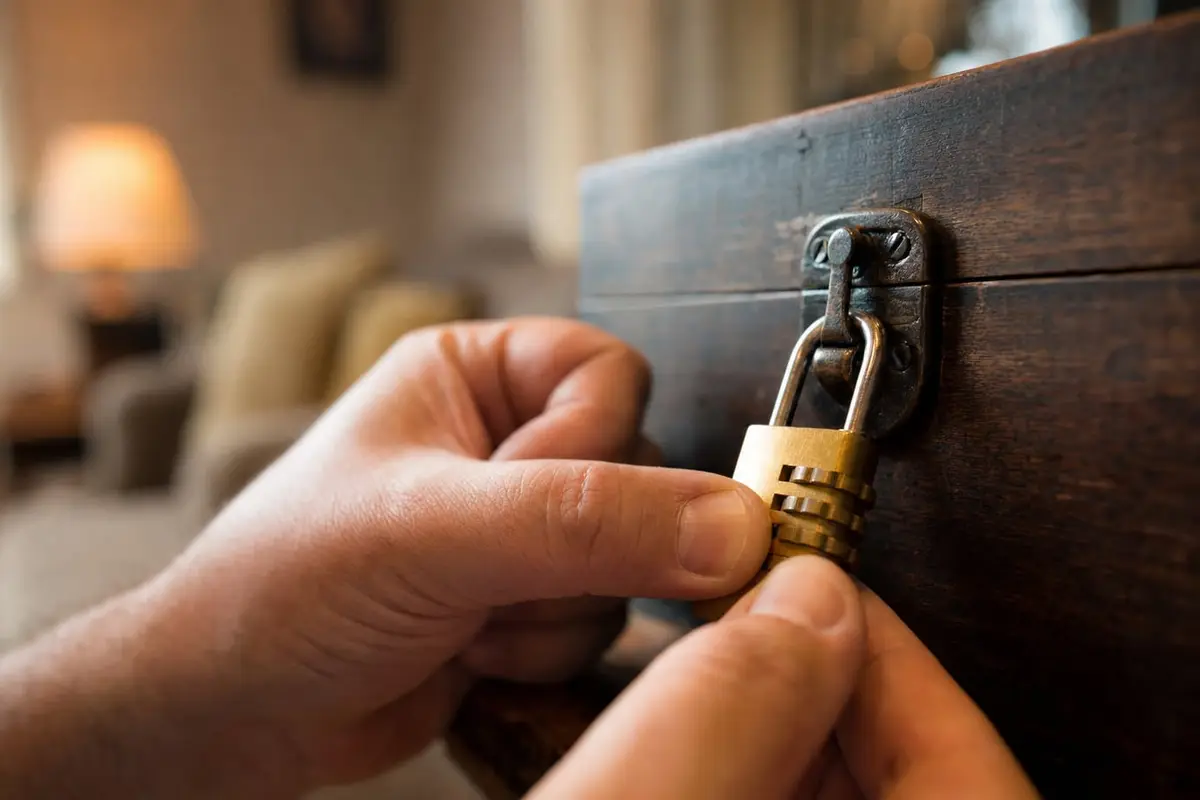
An escape room in a box is a tabletop game that packs a chain of puzzles into one box you solve in about an hour. EXIT checks each answer with a decoder disk, Unlock! with a free app, Deckscape on the back of each card, and Mattel's Escape Room in a Box: The Werewolf Experiment with real padlocks.
Escape room in a box — A boxed tabletop game that recreates an escape room: players solve a chain of puzzles hidden in cards, documents and objects, confirm each answer with a decoder, an app, a solution card or a lock, and race a suggested time limit, usually 60 minutes.
We earn a commission when you buy through links on this page, at no extra cost to you. Commissions never decide which games we pick or their order. As an Amazon Associate I earn from qualifying purchases. Affiliate disclosure
The short version
An escape room in a box takes the format of a real escape room, a team solving puzzles against the clock to reach a goal, and moves it onto your kitchen table. There is no locked door. Instead, the “room” is a deck of cards, a booklet, a few sealed envelopes or a wooden box, and every solved puzzle gives you a code, a card number or an object that opens the next step.
What changes from one box to another is how the game knows you are right. EXIT: The Game uses a cardboard decoder disk. Unlock! uses a free smartphone app. Deckscape prints the solution on the back of each card. Mattel’s Escape Room in a Box: The Werewolf Experiment uses real padlocks. Once you know which checking system a box uses, you know most of what the evening will feel like.
The table below sums up the main formats sold in the US. The sections after it explain each one, then cover contents, hints, time, player count and replay.
| Format | Examples | How answers are checked | Players | Typical time | Replay |
|---|---|---|---|---|---|
| Single-adventure box | EXIT: The Game, Clue Escape | Decoder disk, answer cards, a board that builds as you go | 1 to 4 (EXIT), 1 to 6 (Clue Escape) | 1 to 2 hours | EXIT is single use |
| Card series | Unlock!, Deckscape | Free app (Unlock!), card backs (Deckscape) | 1 to 6 | About 60 minutes per adventure | Cards stay intact |
| Box with physical locks | Escape Room in a Box: The Werewolf Experiment, Escape Room The Game | Padlocks, keys, an electronic decoder | 2 to 8 | 60 minutes | Can be repacked |
| Mechanical puzzle box | iDventure Cluebox | The box opens step by step | 1 to 2 | 60 to 90 minutes | Can be reset |
| Calendar or envelope | EXIT advent calendars, Puzzle Post | A daily riddle card, a solution sheet | 1 to 8 | 10 minutes a day to 90 minutes | Mostly single use |
The main formats
Single-adventure boxes
A single-adventure box holds one story and one chain of puzzles, played in one sitting. EXIT: The Game, designed by Inka and Markus Brand and published by Kosmos (Thames & Kosmos in the US), is the reference here: the series won the 2017 Kennerspiel des Jahres, the German award for connoisseur games. A box like EXIT: The Abandoned Cabin contains a booklet, riddle cards, answer cards, help cards, a decoder disk and a few strange objects. The box says 1 to 4 players, ages 12 and up, and 1 to 2 hours.
Hasbro’s Clue Escape line blends the format with the classic whodunit. In Clue Escape: The Midnight Hotel, the board is built room by room as you solve puzzles, and you finish by naming who, where and what, as in Clue. The box lists 1 to 6 players, ages 10 and up, and a difficulty of 3.
Card series
Card series put each adventure in a deck of numbered cards. In Unlock!, from the French publisher Space Cowboys, you flip a card that shows a room, look for hidden numbers, and combine a red object card with a blue one by adding their numbers to find the next card. Codes go into a free app that also runs a 60-minute timer and plays music. A box such as Unlock! Escape Adventures contains three adventures, each with its own difficulty level from 1 to 3, for 1 to 6 players aged 10 and up.
Deckscape, from the Italian publisher dV Giochi, needs no app. Each game is a deck of 60 large cards; you answer a puzzle, flip the card and read the solution on the back. A wrong answer earns an X on the score sheet, and the rulebook adds two minutes to your final time for each X.
Boxes with physical locks
Some kits use real padlocks and keys, which feels closest to a venue escape room. The Werewolf Experiment has players solve 19 puzzles to find the codes of three locks within an hour. Identity Games’ Escape Room The Game uses an electronic Chrono Decoder that counts down from 60 minutes: you insert keys to test your answers and use it to take hints.
Mechanical puzzle boxes
A wooden puzzle box is an escape room you hold in your hands. The iDventure Cluebox: Captain Nemo’s Nautilus is a laser-cut birch box that opens through a series of logic steps; the maker lists 1 to 2 players aged 14 and up and 60 to 90 minutes, and the box can be reassembled for the next player. These suit one or two solvers more than a group, since only one person can handle the box at a time.
Calendars and envelopes
Escape room advent calendars spread one story over 24 doors in December, with a short riddle behind each. The EXIT calendars take about 10 minutes a day, according to Room Escape Artist. Puzzle Post’s escape room in an envelope holds ten puzzles for 1 to 8 players and about an hour of play. Our list of the best escape room advent calendars compares the current calendars.
What comes in the box
Contents vary by format, but most boxes mix four kinds of material:
- Story material: an intro card or booklet that sets the goal, such as finding a way out of a cabin or brewing an antidote before the full moon.
- Puzzle material: riddle cards, maps, letters, photos, ciphers and, in some boxes, physical objects such as a strip of film or a cardboard wheel.
- A checking tool: the decoder disk, the app, answer cards, padlocks or a solution booklet.
- Help: hint cards, hint pages or an in-app hint button.
Read the side of the box before you play. It tells you the player range, the age rating, whether you need a phone, and whether you will need scissors, a pen or a flashlight. EXIT boxes, for example, warn that you will mark up, fold and tear the game materials.
How you check your answers
The checking system is the heart of any escape room in a box. It stops you from guessing your way through and it controls the pace.
- Decoder disk (EXIT). Each lock is a symbol around the edge of the disk. You dial your code under that symbol, read the number that appears in the small window, and look up that answer card, which tells you whether you are right and what to do next.
- App (Unlock!). You type the code you found into the app, which tells you whether it is right. Wrong deductions can reveal penalty cards, and each penalty takes a few minutes off your clock.
- Card backs (Deckscape). You settle on an answer, flip the card and read the solution. Each wrong answer is marked on the score sheet.
- Locks and keys (Werewolf Experiment, Escape Room The Game). A padlock either opens or it does not. Electronic decoders work the same way with keys.
- The board itself (Clue Escape). New rooms of the 3D board open as you solve puzzles, and the final accusation is checked against the solution.
How hints work
Every good escape room in a box gives you a way out when you are stuck, because a game that stalls on one puzzle loses the table. EXIT gives each of its 10 codes a small stack of help cards: a first clue that tells you which cards and objects you need, a second clue that explains how they fit together, and a solution card. The Unlock! app offers several hints per card, and the publisher also posts full solutions online. Deckscape’s solutions sit on the card backs, and Escape Room The Game pairs a set of hint cards with a hint decoder.
Most games score you on time and on the help you used. EXIT lowers your final score for each help card that taught you something; the Unlock! app counts your hints. The score matters far less than finishing, so ask for a hint after five minutes without progress on the same puzzle.
How long it takes
Plan on an hour, then add a margin. Unlock! adventures are built around 60 minutes each, EXIT boxes list 1 to 2 hours, Deckscape’s rulebook says about 30 to 90 minutes, and Mattel’s Werewolf Experiment uses a one-hour limit. A first game always runs longer, because part of the time goes into learning how the cards and the checking system work. Calendars are the exception: about 10 minutes a day over 24 days.
How many players
Publishers print a range, and the top of that range is optimistic. EXIT boxes are sold for 1 to 4, Unlock! and Deckscape for 1 to 6, and The Werewolf Experiment for 2 to 8. In practice, two to four players can all reach the cards at once. With five or six, some people end up watching. For a bigger group, buy two different boxes and swap halfway, or run a DIY escape room with puzzles spread around the house.
Can you replay it?
Not in the sense of solving it again: once you know the answers, the surprise is gone. The real question is whether you can pass the box on.
- Single use: EXIT boxes ask you to cut, fold and write on components, so they are finished after one game. Clue Escape is also sold as a one-time solve.
- Pass it on: Unlock! and Deckscape keep every card intact, as long as you put them back in order. Wooden puzzle boxes like the Cluebox are reset by reassembling them.
- Repack: Room Escape Artist notes that Mattel’s Werewolf Experiment can be repacked for another group, even though the puzzles stay the same.
“Escape Room in a Box,” the brand
“Escape room in a box” is a generic phrase, but it is also the name of a specific game. Escape Room in a Box: The Werewolf Experiment was created by Juliana Moreno Patel and Ariel Rubin under the name Stay At Home Werewolves. Their Kickstarter drew more than two thousand backers, and only 3,000 first editions were made. In August 2017 the designers announced that they had licensed the game to Mattel, which released its retail version that November.
In the Mattel edition, a lab experiment has gone wrong and your group will turn into werewolves unless you solve 19 puzzles, open three locks and find the antidote within one hour. Players with an Amazon Alexa device can use it to keep time, answer questions and play a soundtrack, but the game works without it. Board game databases list it for 2 to 8 players aged 13 and up.
So when someone says “escape room in a box,” they may mean the whole format, from EXIT to Unlock!, or this one Mattel title. The term “escape room kit” is just as loose: some sellers use it for ready-to-play boxes, others for props such as padlocks, invisible-ink pens and decoder wheels that you use to build your own puzzles.
Picking your first box
Start with the group, then the checking system. Two to four adults who like paper puzzles and do not mind cutting cards will enjoy EXIT. A family that wants a timer and sound effects, and keeps a phone on the table anyway, will like Unlock!. A group that wants to keep the box intact or play while traveling should look at Deckscape. If you want padlocks you can actually open, look for a box with physical locks.
Then match the difficulty. Every publisher rates its own titles, and the scales do not line up; our guide to easy vs hard escape room games explains how to read them. When you are ready to buy, compare the best escape room games for home and the best escape room board games, or browse the Escape Rooms at Home hub for every guide on the subject.
Key facts
- Mattel's Escape Room in a Box: The Werewolf Experiment asks players to solve 19 puzzles that give the codes to three locks within a one-hour limit; an Amazon Alexa device can optionally track the time, answer questions and play a soundtrack.ICv2, 2017
- Escape Room in a Box: The Werewolf Experiment was designed by Juliana Moreno Patel and Ariel Rubin, first published in 2016, and is listed for 2 to 8 players aged 13 and up, with 30 to 90 minutes of play.Board Game Oracle (BoardGameGeek data), 2026
- In EXIT: The Game, each of a scenario's 10 codes has its own stack of tiered help cards (a first clue, a second clue, then the solution), and every help card used lowers the final score.Meeple Mountain, EXIT: The Game mega review, 2019
- Unlock! scenarios use numbered cards and a mandatory free app that checks codes, runs the timer (usually 60 minutes) and gives hints; the final score depends on the time taken and the number of hints used, for 1 to 6 players.Wikipedia, Unlock!, 2026
- Exit: Das Spiel by Inka and Markus Brand, published by Kosmos, won the 2017 Kennerspiel des Jahres; it uses a decoder wheel and cards to present a series of puzzles.ICv2, Spiel des Jahres 2017 winners announced, 2017
FAQ
What is the difference between an escape room in a box and an escape room kit?
Most people use the two terms for the same thing: a boxed game with a ready-made chain of puzzles, such as EXIT or Unlock!. Some sellers also use "escape room kit" for printable sets or props, like padlocks and decoder wheels, that you use to build your own room.
How long does an escape room in a box take?
Most are built around one hour. Unlock! adventures run about 60 minutes each, EXIT boxes list 1 to 2 hours, and Mattel's Werewolf Experiment uses a one-hour limit. Expect more time on a first game while the group learns how the answers are checked.
Can you play an escape room in a box more than once?
Usually not, because the puzzles stay the same once you know them. EXIT boxes are single use since you cut, fold and write on the components. Unlock!, Deckscape and wooden puzzle boxes such as the iDventure Cluebox stay intact, so you can pass them on to friends.
How many people can play an escape room in a box?
EXIT is sold for 1 to 4 players, Unlock! and Deckscape for 1 to 6, and The Werewolf Experiment for 2 to 8. With more than four or five people, players start waiting for their turn to read a card, so split big groups across two boxes.
Do you need a phone to play an escape room in a box?
It depends on the series. Unlock! requires its free app to enter codes and run the timer, though the box copy says no internet connection is needed. EXIT, Deckscape and Clue Escape check answers with cards, a decoder disk or the board itself, so they play without a screen.
Sources
- ICv2: Mattel's Escape Room in a Box: The Werewolf Experiment
- Cardboard Republic: Werewolves come to Mattel
- Room Escape Artist: Escape Room in a Box, The Werewolf Experiment revisited
- Board Game Oracle: Escape Room in a Box: The Werewolf Experiment
- Meeple Mountain: EXIT: The Game mega review
- ICv2: Spiel des Jahres 2017 winners announced
- Wikipedia: Unlock!
- Space Cowboys: Unlock! (English)
- Meeple Mountain: Deckscape mega review
Keep investigating
- The Best Escape Room Games to Play at Home
- The Best Escape Room Board Games: EXIT, Unlock! and More
- Easy Escape Room Games (and Hard Ones): How to Pick the Level
- DIY Escape Room: How to Make an Escape Room at Home
- Best Escape Room Advent Calendars: One Puzzle a Day Until Christmas
- Escape Room Games to Play at Home