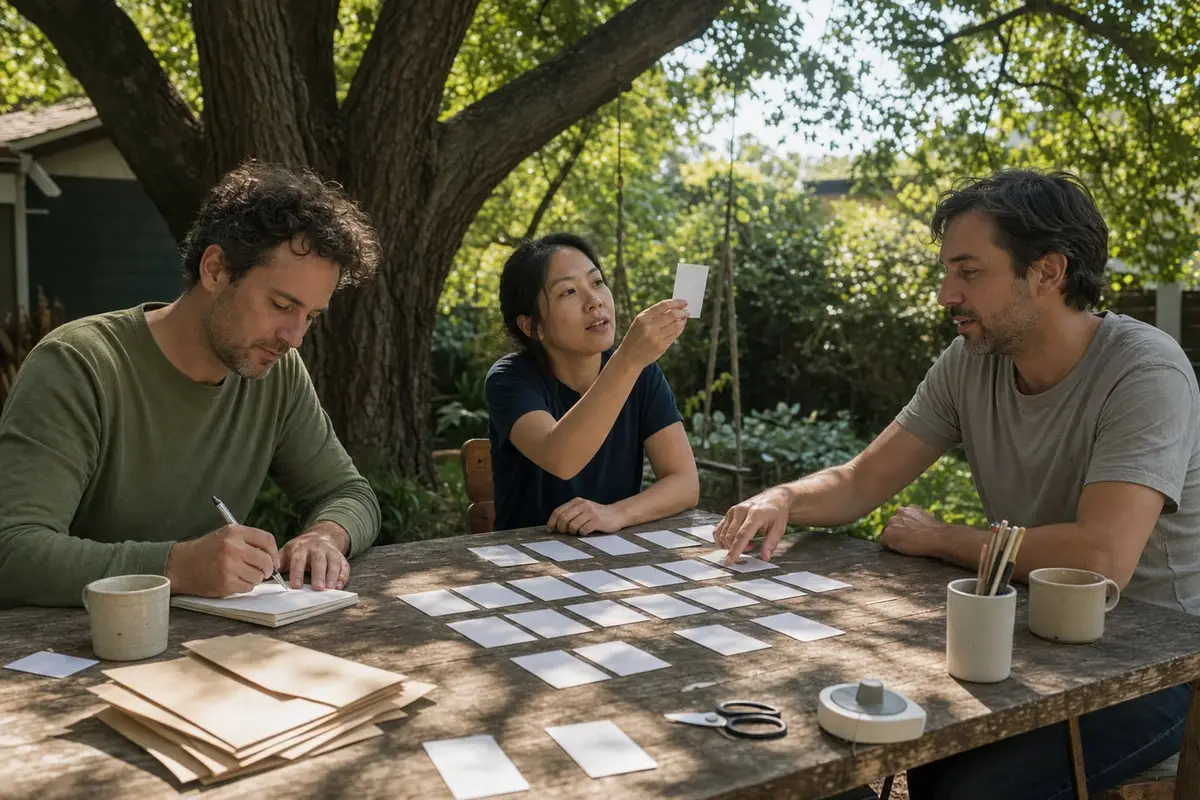
To win a boxed escape room game, read the rules aloud before touching the contents, lay every item where all players can see it, keep one shared page of notes, test every combination in order, and ask for the lowest hint level when the group stalls. Cut, fold or write only when the rules allow it.
Tiered hint system — A way of giving help in steps, from a first nudge that names what matters, to a second that explains how the pieces combine, to the full solution, so a stuck team can take only as much help as it needs.
We earn a commission when you buy through links on this page, at no extra cost to you. Commissions never decide which games we pick or their order. As an Amazon Associate I earn from qualifying purchases. Affiliate disclosure
The short list
These habits make the biggest difference once the box is on the table:
- Read the rules together, aloud, before anyone opens anything.
- Put every item in view and never keep a card in your hand “for later.”
- Share one page of notes with codes tried, pairs tested and open questions.
- Name a keeper of what is already solved, so nothing is discarded by mistake.
- Check every combination in order, and recheck the entry before you doubt the puzzle.
- Agree on a hint rule before the timer starts, then take the lowest level first.
- Cut, fold or write only when the rules say so.
This guide is about playing a game you already own. To pick one, see the best escape room games; to build your own, read how to make a DIY escape room.
Before you open the box
Read the rules aloud as a group. EXIT’s manual opens by telling players to read it together out loud and not to look closely at the cards or the book yet. The Unlock! leaflet says not to look at the cards before you start, and Deckscape says not to look through or shuffle the deck, which is in a fixed order. In every case, the first mistake is a spoiled puzzle.
Gather the supplies. The EXIT manual lists a pen, a pencil, scissors, paper for notes and a watch, with a free app timer as an alternative. Deckscape asks for paper, a pencil and a clock. Unlock! needs a phone or tablet with its free app, which is required to play, within easy reach of everyone.
Check that the game is complete. Unlock! tells you to verify the deck before starting, using the card numbers on the card backs. A missing card halfway through is a far worse surprise than a five-minute check.
Set up the space. Clear a table big enough to spread every revealed card at once, and use bright, even light: the Unlock! leaflet tells players to examine cards closely for hidden numbers and letters. Keep drinks off the playing surface, since paper gets handled, written on and sometimes cut.
Know what kind of box you have. It decides how freely you can mark things up.
| Single-use games | Reusable games | |
|---|---|---|
| Examples | EXIT titles such as EXIT: The Abandoned Cabin | Unlock! Escape Adventures, Deckscape |
| Write, fold, cut | Allowed, sometimes required | Leave components intact |
| Notes go on | The game or separate paper | Separate paper only |
The EXIT manual says you can write on, fold or cut the materials, that this is sometimes required, and that the game can be played only once. Meeple Mountain’s review agrees: each EXIT game is played once because its materials are marked up, torn, cut and folded. Wikipedia notes that Unlock! components are not destroyed or altered during play, so others can reuse them. Notes on a reusable card would spoil the next team’s game.
Organize the table and the team
Everything visible. Unlock! asks for revealed cards to be placed faceup so everyone sees them, and not to spread out the draw pile. Scott Nicholson’s survey of escape room facilities describes the same behavior in venues: well-communicating teams call out what they find and organize items that might go together.
Split the work, but keep one picture. The Unlock! leaflet offers two ways to search: one player looks for and reveals new cards, or the deck is split among players. Its tips add: read each card carefully and share information. With many leads, pair up; with one clue, stay together.
Give each person a job.
- Reader: reads each new card aloud once. Rotate the job.
- Scribe: keeps the shared notes.
- Keeper: guards items that are solved, set aside or not yet usable. The Unlock! leaflet warns you to check for errors when discarding, and EXIT keeps its strange items at the edge of the table until the game says you have found them.
- Timekeeper: watches the clock and calls the hint check.
Do not all read at once. When four people read four cards aloud, nobody hears anything.
Work in parallel when the game allows it. Deckscape’s official demo round splits the cards into decks by color and says you can try the decks simultaneously or focus together on one puzzle. EXIT’s riddles must be solved in order, so there the shared work is thinking, not searching.
Take notes you can use
Both publishers expect notes: the Unlock! leaflet says players can take them, and the EXIT manual lists paper for notes among its supplies. Keep them short and sorted:
- Numbers and symbols seen, with the card where you saw them.
- Codes and answers already tried, wrong ones included.
- Pairs already combined, in a grid, so gaps show at a glance.
- A “parking lot” of found objects with no use yet.
- Odd details, such as a number that does not fit or an item mentioned twice.
Put the page in the middle of the table, not in one person’s lap.
Check every combination
Many boxed games are built on combining things, so a stall often calls for a more orderly search, not a cleverer idea.
- Combine in order. In Unlock!, a blue card combines with a red card or a red modifier, and the other way around; if the result matches a card in the deck, you reveal it. List the red and blue items and tick off pairs.
- Look closer. Objects are not always obvious, and hidden letters or numbers may match cards in the deck.
- Recheck the entry. When an EXIT code fails, the manual says to check the symbol and the order of the numbers, and to compare the decoder disk symbol with the one on the riddle card, before rethinking the riddle.
- Do not brute-force it. The EXIT manual says every code can be solved logically and that you should not try all possible combinations. In Deckscape, each wrong answer adds 2 minutes to your final time.
When one puzzle blocks the table
Run the same routine every time:
- Reread the card aloud, word for word. Small words such as “only” or “after” often carry the key.
- List what you hold that could belong to this puzzle.
- Pass it on. Hand the card to someone who has not touched it.
- Switch threads if the game has more than one open. Unlock!‘s “Still stuck?” advice says you may need to move forward before you can understand how to combine objects or use a machine.
- Look for a missed object. The same leaflet says you may have overlooked a hidden one.
- Ask for a hint once you pass your agreed limit.
Use hints well
A boxed game has no gamemaster, so the table must decide what one would. In Nicholson’s survey, 42% of facilities let players request hints whenever they need them, and proprietors reported that many players do not ask and instead suffer in frustration. The paper also says a good gamemaster knows when a team needs help and when it is on the edge of a breakthrough. Agree on your rule before the clock starts. Our rule of thumb, not a publisher’s, is to ask after about ten minutes without a new idea.
Take the smallest hint first. The publishers build their systems that way:
- EXIT gives each code three Help Cards: a 1st Clue that says what you need and gives a first hint, a 2nd Clue with more concrete help, and a Solution. The manual says “Don’t be shy about using Help Cards.” Read the first, and keep the others face down.
- Unlock! gives hints in the app: you enter the number of the card that troubles you, and on some cards a second hint and possibly the solution follow. Asking about one card keeps the help narrow.
- Deckscape is checked by flipping the card, and its rulebook as transcribed by RulesPal describes no hint system, so your own rule matters even more.
Do not pay for nothing. The EXIT assessment table counts only Help Cards that gave new hints or solutions, and Meeple Mountain likes that a card confirming what you already know is not penalized.
Let one person open hints, so nobody reads ahead by accident.
Solo or group
Unlock! is designed to be played solo or cooperatively and is listed for 1 to 6 players. Deckscape is also 1 to 6, and EXIT: The Haunted Roller Coaster is for 1 to 4. Alone, you lose parallel searching but control the notes and the pace; read aloud anyway, because hearing a clue changes how you see it. At three or four players, rotate the reader so one loud player does not hold every card. Beyond that, split into pairs so nobody waits for the next card.
Nicholson’s survey adds that the most successful teams have a variety of experiences, skills and backgrounds, so give a newcomer the reader job. For the level to start at, see easy vs hard escape room games.
Time and breaks
Unlock! runs a countdown, usually 60 minutes according to Wikipedia, and is designed to be played without interruption; if you must stop, resolve any machines you have met before leaving the app. EXIT uses a stopwatch or the app timer, and nothing in its manual says the session has to be continuous.
- Allow a full evening the first time, since part of it goes into learning how answers are checked.
- Pause just after a puzzle is solved, never in the middle of one.
- Leave a single-use game as it is, notes on top and the current card marked.
- Step away when stuck. A short break often breaks the habit of staring at the same card.
Common mistakes
- Marking up a reusable game, which ruins it for the next team.
- Holding back in a single-use game. Cutting and folding are often part of the puzzles.
- Peeking at answer cards. The EXIT manual allows an Answer Card only after you enter a code and are sent to it.
- Throwing away the wrong card. In Unlock!, crossed-out numbers or letters show which cards to set aside.
- Misusing a machine. The Unlock! leaflet warns that it can cost you time.
- Guessing for speed. Random codes are exactly what the EXIT manual says not to try.
- Hoarding cards. A card in one hand is a clue the others cannot use.
After the game
A short debrief teaches more than the next box: which clue took longest, which hint was needed, and why the group missed it. To see how different boxes check answers, read how an escape room in a box works, then compare the best escape room board games. Every guide on the subject is in the Escape Rooms at Home hub.
Key facts
- EXIT: The Haunted Roller Coaster tells players to read the manual together out loud before looking at any material, allows them to write on, fold or cut the components, and says the game can be played only once; it lists a pen, a pencil, scissors, paper for notes and a watch as extra supplies.Kosmos / Thames & Kosmos, EXIT: The Haunted Roller Coaster manual, 2019
- The same EXIT manual states that all codes can be solved logically and that players should not try every possible combination on the decoder disk; each code has three Help Cards (1st Clue, 2nd Clue, Solution), and only Help Cards that gave new information count in the final assessment.Kosmos / Thames & Kosmos, EXIT: The Haunted Roller Coaster manual, 2019
- The Unlock! rules leaflet lets players take notes, suggests either one player who searches for and reveals cards or splitting the deck among players, requires revealed cards to be placed faceup so everyone sees them, and offers a per-card hint button in the app, with a second hint on some cards.Space Cowboys, Unlock! rules leaflet, 2025
- Unlock! adventures are designed to be played without interruption; a team that has to quit the app before the end should first resolve any machines it has already met so it can resume where it left off.Space Cowboys, Unlock! rules leaflet, 2025
- In a survey of 175 escape room facilities, 42% let players request hints whenever they need them, and proprietors reported that many players do not ask and instead suffer in frustration; the paper also notes that well-communicating teams call out what they find and organize items that might go together.Scott Nicholson, Peeking Behind the Locked Door: A Survey of Escape Room Facilities, 2015
- In Deckscape, a wrong answer earns an X on the score sheet and each X adds 2 minutes to the final time, so careless guessing costs more than a short pause to discuss.Deckscape: Heist in Venice rulebook, RulesPal, 2026
FAQ
What is the best tip for an escape room game at home?
Put every item where all players can see it and keep one shared page of notes. Most stalls in a boxed game come from a clue that one person saw and nobody else did, or from a combination that was tried twice and never written down.
How long should you wait before asking for a hint?
No publisher sets a number, so agree on one before you start. A workable rule of thumb is to ask when ten minutes pass without a new idea, and to take only the first level of help. In EXIT, a help card that gives you nothing new does not count against your final assessment.
Can you play an escape room game alone?
Yes. Unlock! is designed to be played solo or cooperatively, Deckscape is listed for 1 to 6 players, and EXIT: The Haunted Roller Coaster is for 1 to 4. Alone, you lose parallel searching but gain full control of the notes and the pace.
Can you pause an escape room game and finish it later?
Sometimes. Unlock! is designed to be played without interruption, and its leaflet tells you to resolve any machines you have met before quitting the app. EXIT and Deckscape are timed with a stopwatch or clock you control, so stopping it between two puzzles is your call.
What should you not do in an escape room game?
Do not cut, fold or write on a game unless its rules allow it, do not look at answer cards early, and do not try every code on a decoder. EXIT says its codes can all be solved logically, and Unlock! games are meant to stay intact for the next player.
Sources
- Scott Nicholson: Peeking Behind the Locked Door, a survey of escape room facilities (white paper)
- Kosmos / Thames & Kosmos: EXIT, The Haunted Roller Coaster (official manual)
- Space Cowboys: Unlock! rules leaflet (2025)
- Meeple Mountain: EXIT: The Game mega review (tiered help cards, single use)
- RulesPal: Deckscape, Heist in Venice rulebook
- Wikipedia: Unlock!