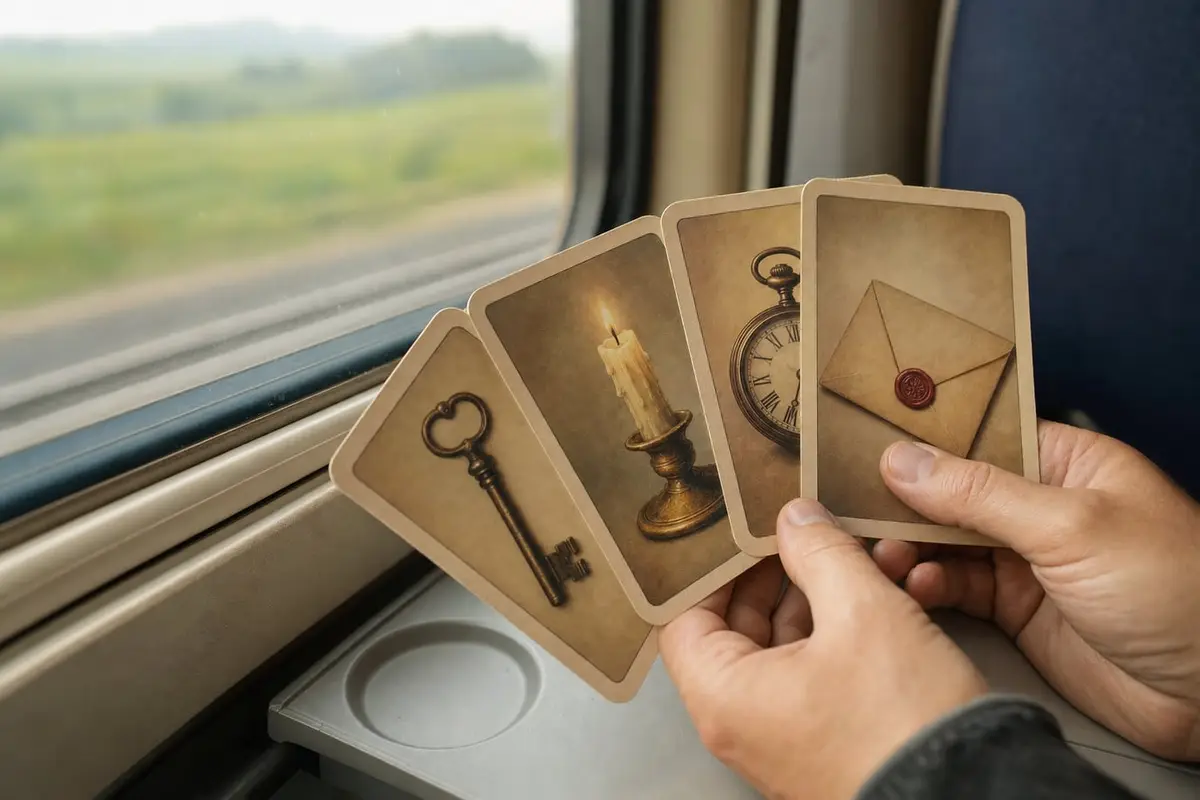
The best mystery card game for most groups is University Games' 30 Second Mysteries, a tin of short cases solved by asking questions as clues come out. Pick Professor Puzzle's The Crypto Killer for a one-hour case in cards, Ravnica: Clue Edition if you play Magic: The Gathering, and Guess Who? Scooby-Doo Villains for children from 5.
Mystery card game — A short game played mostly with cards in which players work out a hidden answer, such as a culprit, an explanation or a case-file combination, by revealing clues and asking questions rather than moving pieces on a board.
We earn a commission when you buy through links on this page, at no extra cost to you. Commissions never decide which games we pick or their order. As an Amazon Associate I earn from qualifying purchases. Affiliate disclosure
At a glance
| Game | Players | Playing time | Age | Difficulty | Format |
|---|---|---|---|---|---|
| 30 Second Mysteries | 2+ | — | 8+ | — | Tin of 64 mystery cards, question-and-answer |
| Professor Puzzle: The Crypto Killer | 1+ | About 60 min | 12+ | — | Card-based case: 54 cards, 4 crime scenes |
| Magic: The Gathering – Ravnica: Clue Edition | 3–4 (plays with 2) | — | — | Requires Magic: The Gathering rules | 8 boosters, 21 Evidence cards, case file envelope, screens, notepad |
| Guess Who? Card Game: Scooby-Doo Villains Edition | 2 | About 15 min | 5+ | — | Question-and-answer deduction card game |
Our picks
30 Second Mysteries
A tin of 64 cards from University Games' Mystery, Mind and Logic line, where each case reads in about 30 seconds and the group questions its way to the answer. Two or more players, ages 8 and up, and it fits in a coat pocket. The cases are short riddles, so players who want evidence and suspects should look at The Crypto Killer.
Professor Puzzle: The Crypto Killer
A single murder case told through 54 cards, four crime scenes and a reference chart, solved alone or in a group in about an hour. Rated 12 and up. Once solved, it is finished, like any story case.
Magic: The Gathering – Ravnica: Clue Edition
Eight ready-to-play Magic boosters plus 21 Evidence cards, a Case File envelope, screens and a notepad: you win by defeating opponents or by solving the Clue-style case. Built for three or four players. You need to know the rules of Magic: The Gathering, so it is not a first card game.
Guess Who? Card Game: Scooby-Doo Villains Edition
A two-player card version of Guess Who? in which children ask yes-or-no questions to unmask a Scooby-Doo villain. Rated 5 and up, with rounds of about 15 minutes. It is pure question-and-answer elimination, with no story to read.
What makes a mystery card game
A mystery card game is the shortest way to put a puzzle on the table. There is no board to set up and often no rulebook to learn: someone reads a card, and the group starts asking questions. The games on this page fall into four styles, and knowing which one your group wants does most of the choosing.
- Riddle cards. 30 Second Mysteries gives you a short case and a question. In the original rules, clues come out one at a time, each team has 30 seconds to read a clue and ask the other team a question, and a wrong solution hands the point to the other side. The first team to five points wins.
- A case told in cards. Professor Puzzle’s The Crypto Killer turns a single murder investigation into 54 cards, four crime scenes and a reference chart. You read evidence, solve small puzzles and name the culprit in about an hour.
- A card game with a case file. Ravnica: Clue Edition is a game of Magic: The Gathering with a Clue layer. A suspect, a weapon and a room go into a Case File envelope. When you deal combat damage to a player, you make a suggestion, and each player gets one accusation.
- Question-and-answer elimination. Guess Who? Scooby-Doo Villains strips deduction to its core: two players, one hidden villain each, and yes-or-no questions until one is unmasked.
All four ask for the same thing: careful questions and elimination. Our guide on what a deduction game is explains how those families of games differ and why hidden-role games are not part of this list.
The four games side by side
| Game | Style | Players | Time | Age |
|---|---|---|---|---|
| 30 Second Mysteries | Riddle cards, team questions | 2 or more | Minutes per case | 8+ |
| The Crypto Killer | Single case in cards | 1 or more | About 60 minutes | 12+ |
| Ravnica: Clue Edition | Magic game with a Clue case file | 3 to 4 (plays with 2) | One Magic game | Magic players |
| Guess Who? Scooby-Doo Villains | Yes-or-no elimination | 2 | About 15 minutes | 5+ |
How to pick between them
- A mixed group, a car trip or a dinner table: 30 Second Mysteries. The tin travels, and the game scales to any number of guessers.
- One or two people who want a real case: The Crypto Killer. It has suspects, evidence and puzzles, and plays like a small boxed case without the paperwork.
- A Magic: The Gathering group that wants something new: Ravnica: Clue Edition. The Clue cards are also playable Magic cards, and the Evidence cards can be added to other Magic games for a fresh case each time.
- Children aged 5 to 8: Guess Who? Scooby-Doo Villains. The questions are simple and the villains are familiar.
- A group that wants more than a card game: move up to a detective board game, where a case runs for 15 to 90 minutes with maps, testimony and scoring.
What comes in the box
- 30 Second Mysteries: a tin of 64 cards. The original edition read each card through a stand with red film that revealed the clues one at a time and hid the solution under a flap; the tin keeps the short cases and the 30-second idea in a pocket format.
- The Crypto Killer: 54 cards, four crime scenes, a reference chart and a how-to-play guide. The story follows a homicide detective investigating the death of a cryptocurrency investor who had conned investors out of millions.
- Ravnica: Clue Edition: eight boosters of 20 Magic cards each, 21 Evidence cards (six suspects, five weapons and ten locations, all playable as Magic cards), four hidden information screens, an evidence notepad, a Case File envelope and a storage box.
- Guess Who? Scooby-Doo Villains: a deck of villain cards for two players, with questions about masks, costumes and disguises.
Mystery card games by age
- Ages 5 to 7: Guess Who? Scooby-Doo Villains. The questions are about what each villain looks like, and a round lasts about 15 minutes.
- Ages 8 to 11: 30 Second Mysteries. Children can play on a team with adults, and the short cases suit short attention spans at the end of a meal.
- Ages 12 and up: The Crypto Killer, which asks players to compare evidence across several cards, and the full range of riddle cards.
- Magic players: Ravnica: Clue Edition. The box does not set an age on its listing, so the real requirement is knowing how to play Magic: The Gathering.
Why Black Stories is not on the list
Black Stories is the card game most people think of when they search for mystery card games. It works like a lateral-thinking riddle: one player reads a strange situation, keeps the explanation secret, and the others ask yes-or-no questions until they reconstruct what happened. The format is excellent and plays in about 15 minutes.
The content is another matter. Its German publisher, moses. Verlag, rates the English edition for ages 14 and up and describes its 50 stories as morbid and sinister: almost every card is built around a death. That puts it outside what we recommend on this site, and we did not find a gentler edition confirmed in stock on Amazon.com on October 25, 2026. If you like the question-and-answer format but not the theme, 30 Second Mysteries uses the same skill of asking narrow questions, with cases that suit a family table.
Other games we looked at
Several cards-only mystery games did not make the list. Card escape games such as EXIT, Unlock! and Deckscape are excellent, but they are built around locks and codes, so we cover them with escape rooms rather than here. A bluffing card game sold with a detective theme was left out because we could not confirm its rules involve any investigation. A European crime card game for one to six players looked promising, but we could not confirm that the copy sold in the US has English cards. We also excluded a trump card deck about real serial killers and a long cooperative horror card game, which is neither short nor in the spirit of this page.
Getting the most from a short mystery
Short games reward good questions more than lucky guesses.
- Ask questions that split the possibilities in half. “Was it someone inside the house?” removes more than “Was it the gardener?”
- Write down what is ruled out. Even a 15-minute game is easier with a scrap of paper.
- Do not guess early. In 30 Second Mysteries, a wrong solution gives the point to the other team.
- Read the case twice. The wording of a riddle card is precise, and the answer often hides in a word you skimmed.
For a full method, from building a timeline to testing a theory, see our guide on how to think like a detective.
A warm-up before a longer case
Because they take minutes rather than hours, mystery card games work well at the start of a game night. A few rounds of 30 Second Mysteries get a group used to asking narrow questions and saying out loud what has been ruled out, which is exactly the habit a longer case needs. Guess Who? Scooby-Doo Villains does the same for children while adults set up a bigger box. After a warm-up, the group can move on to a full investigation such as Sherlock Holmes Consulting Detective or a boxed case, and the table already has a shared way of talking about clues.
Replay value
Riddle cards and case cards are used once per group, because the answer does not change, but a 64-card tin lasts a long time at a few cases per evening. Ravnica: Clue Edition and Guess Who? deal a new hidden answer every game, so they replay indefinitely. The Crypto Killer is a one-time case, best passed on to friends once solved. If you want a longer story, the murder mystery puzzles ranking covers jigsaws and puzzle books that hide a case in a picture, and the detective and deduction games hub gathers every guide and ranking in this topic.
Key facts
- In the original 30 Second Mysteries rules, clues on each card are revealed one at a time, each team has 30 seconds to read its clue and ask a question, a wrong solution gives the point to the other team, and the first team to five points wins.University Games, 30 Second Mysteries Instructions, 1997
- The current 30 Second Mysteries tin, part of University Games' Mystery, Mind and Logic line, contains 64 cards for 2 or more players aged 8 and up; each mystery takes about 30 seconds to read.University Games, 30 Second Mysteries product page, 2026
- Ravnica: Clue Edition, released in February 2024, hides a suspect, a weapon and a room in a Case File envelope; dealing combat damage to a player lets you make a suggestion, and each player gets one accusation to win by solving the case.Star City Games, Ravnica: Clue Edition and How to Solve It for Commander Magic, 2024
- Black Stories, the best-known riddle card game of this kind, comes as 50 cards for 2 or more players aged 14 and up and plays in about 15 minutes; its publisher describes the stories as morbid and sinister.moses. Verlag, black stories English, 2026
How we selected these games
We started from mystery and detective card games sold on Amazon.com and in stock on October 25, 2026, and kept only games built mostly from cards in which players solve something: a case, a riddle or a hidden culprit. We left out card-based escape games, which belong to our escape room rankings, bluffing and hidden-role games without an investigation, imported editions whose English rules we could not confirm, trump card decks about real criminals, and riddle decks whose publisher presents them as morbid. Each pick had to state its player count and age rating or contents, and we checked how each game works against publisher pages, rulebooks and published articles. We kept one game per type of play. We have not played every game on this page: the descriptions come from publishers' information, rulebooks and published coverage. Affiliate commissions do not decide which games appear or their order.
FAQ
What is a good mystery card game for adults?
For a quick round, 30 Second Mysteries works as well with adults as with families, because the cases are riddles rather than children's stories. For a full evening case in cards, The Crypto Killer from Professor Puzzle gives an adult group a murder to solve in about an hour.
Is Black Stories appropriate for kids?
The publisher rates Black Stories for ages 14 and up and describes its stories as morbid and sinister. Each card asks players to work out how a death happened. For children, 30 Second Mysteries (8 and up) or Guess Who? Scooby-Doo Villains (5 and up) are better choices.
Can you play a mystery card game with two players?
Yes. Guess Who? Scooby-Doo Villains is made for exactly two, 30 Second Mysteries needs only two or more, and The Crypto Killer can be played solo or as a pair. Ravnica: Clue Edition is built for three or four but also plays with two.
What is the difference between a mystery card game and a card escape game?
In a mystery card game you identify something hidden, such as a culprit or an explanation. In a card escape game such as EXIT, Unlock! or Deckscape, the cards hold locks and puzzles that you open against a timer. Both are short, but escape games focus on codes rather than suspects.