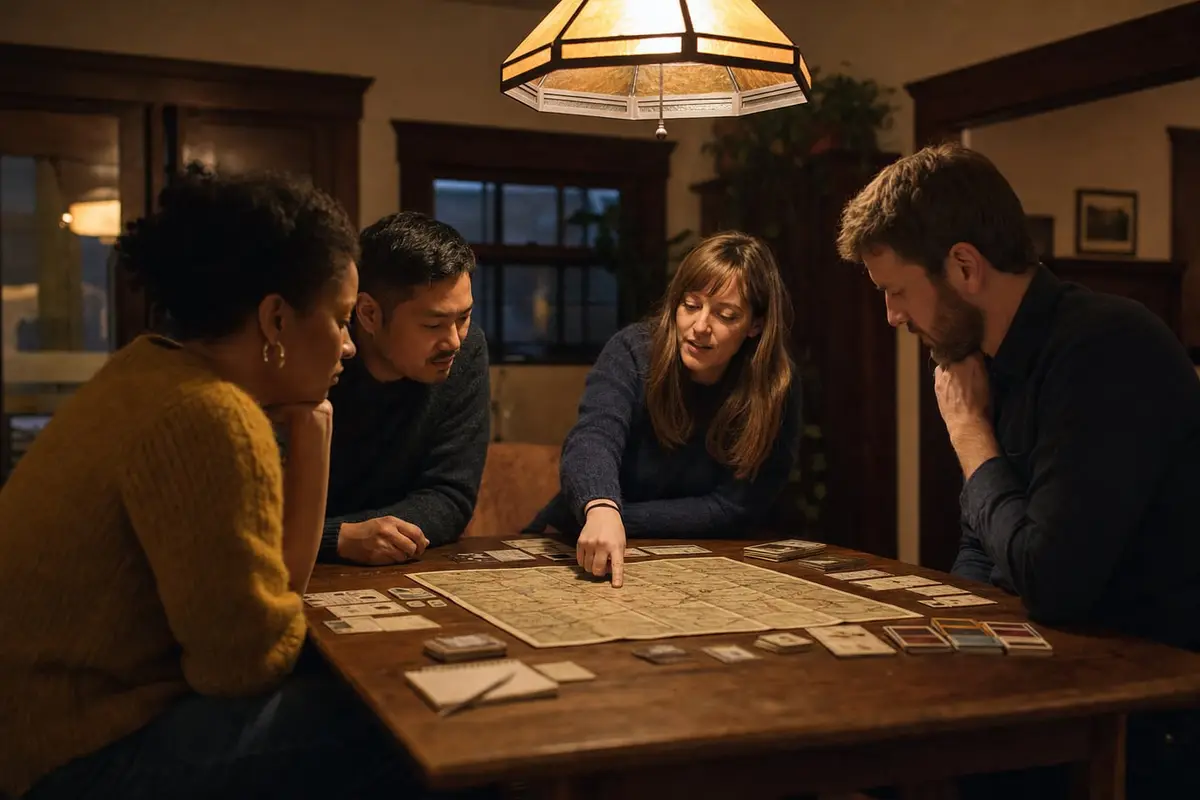
For most groups, Hunt A Killer: Body on the Boardwalk is the best murder mystery board game: a one-sitting case for one or more players aged 14 and up, solved in about an hour. Families should pick Clue: Treachery at Tudor Mansion, a cooperative game for 1 to 6, and competitive groups of two to four Murdle: The Board Game.
Murder mystery board game — A tabletop game in which players work out who committed an invented crime, and usually how and why, by reading clues, cards or documents and eliminating suspects, either together or against each other.
We earn a commission when you buy through links on this page, at no extra cost to you. Commissions never decide which games we pick or their order. As an Amazon Associate I earn from qualifying purchases. Affiliate disclosure
At a glance
| Game | Players | Playing time | Age | Difficulty | Format |
|---|---|---|---|---|---|
| Hunt A Killer: Body on the Boardwalk | 1+ | 45–60 min | 14+ | Medium | Boxed case, one sitting |
| Clue: Treachery at Tudor Mansion | 1–6 | About 90 min | 10+ | — | Cooperative board game, played once |
| Murdle: The Board Game | 2–4 | 20–30 min | 12+ | — | Competitive logic-grid board game, replayable |
| Clue Vintage Bookshelf Edition | 3–6 | — | 8+ | — | Classic competitive board game, replayable |
| MMC Buckingham Palace | 1+ | About 150 min | 12+ | 3/5 (publisher rating) | Case envelope, 43 pieces of evidence |
Our picks
Hunt A Killer: Body on the Boardwalk
A complete case in one box, meant to be solved in a single 45 to 60 minute sitting, which makes it the easiest way to try the Hunt A Killer format without a subscription. It works solo or for a small group around one table. Large groups will find too few documents to go around.
Clue: Treachery at Tudor Mansion
Everyone plays on the same side: you explore the mansion, solve puzzles that open new rooms, then agree on the culprit, room and weapon. Rated for ages 10 and up and 1 to 6 players. It is a one-time story, so it will not come back to the table once solved.
Murdle: The Board Game
Each player holds part of the evidence and fills a logic grid, deciding what to share and what to keep. Games run 20 to 30 minutes and a new case is dealt every time, so it replays well. It needs at least two players and suits people who enjoy logic puzzles more than story.
Clue Vintage Bookshelf Edition
The original Clue rules for 3 to 6 players, in a book-style case with wood movers and a pad of detective notes. Endlessly replayable and simple enough for ages 8 and up. The deduction is lighter than in the modern case games above.
MMC Buckingham Palace
An envelope of 43 pieces of evidence and six suspects, rated 3 out of 5 for difficulty and about 150 minutes of play by the publisher. Good for two people who like reading documents closely. Not a game for players who want board movement or quick turns.
What counts as a murder mystery board game
The phrase covers two quite different kinds of game, and knowing which one you want saves most of the choosing.
The first kind is the replayable deduction game. Classic Clue and Murdle deal a hidden solution at the start of each game. Players gather information turn by turn, cross off suspects, rooms or weapons, and the first person to name the right combination wins. There is little story, but you can play again tomorrow with a different answer.
The second kind is the one-time case. Hunt A Killer boxes, Lucky Egg’s MMC envelopes and Clue: Treachery at Tudor Mansion hand you a written story with documents, puzzles and a fixed solution. You read, compare statements and test theories until the evidence points to one person. Once solved, the box is finished, the same way a mystery novel is finished once you know the ending.
Paper cold case files sit close to the second kind, but they come without a board or cards and rely almost entirely on reading. We cover them in their own ranking of the best cold case games. Games where guests play characters at a dinner are a different format again, covered in the best murder mystery party games.
How to pick between them
Start with the number of people who will actually be at the table, then the time you have.
- One or two players, one evening: a one-sitting case. Hunt A Killer: Body on the Boardwalk is designed for 45 to 60 minutes. The MMC Buckingham Palace envelope is longer, about 150 minutes by the publisher’s estimate, and suits two people who enjoy reading documents side by side.
- A family with children aged 10 and up: Clue: Treachery at Tudor Mansion. Everyone plays on the same team, the board grows as rooms are unlocked, and nobody is left out because they guessed wrong.
- Two to four competitive players: Murdle: The Board Game. Each player sees only part of the evidence, so the game becomes a contest of what to reveal and what to keep.
- A mixed group that wants something familiar: classic Clue. Three to six players, simple rules, ages 8 and up, and no reading load.
If you are unsure what format suits your group, our guide to how murder mystery games work walks through each one with its strengths and limits.
One-time cases versus replayable games
Cost per evening is the usual objection to one-time cases. A replayable game like Clue or Murdle can return to the table every week; a boxed case is played once. In exchange, a case gives you something a replayable game cannot: an invented story with characters, motives and documents that feel like a real file, and a solution that clicks into place when the last clue lines up.
Many households end up owning one of each. A replayable game covers quick nights; a boxed case is kept for a planned evening, the way you might plan a movie night. Cases can also be passed on once solved, as long as nobody writes on the evidence.
What comes in the box
The contents tell you how the game will feel.
- Boxed cases such as Hunt A Killer contain printed documents (letters, reports, witness statements, maps) and often a few physical items or puzzles. You need a table, a notepad and sometimes a phone to check an answer.
- Case envelopes such as MMC hold a stack of evidence sheets. Lucky Egg lists 43 pieces of evidence in the Buckingham Palace case, which is why the publisher estimates a long session.
- Cooperative escape boards such as Treachery at Tudor Mansion combine a modular board with sealed cards that are revealed as players solve puzzles.
- Replayable deduction games come with a board, cards and score sheets. Murdle adds logic grids, evidence folders and a privacy screen for each player; classic Clue includes a pad of detective notes.
None of the games on this page require an app to play, although some cases offer online answer checks or hints.
Getting a good game night out of a case
A few habits make a one-time case run smoothly, especially for first-timers.
- Read the opening letter aloud. It sets out the question you are answering, which is easy to lose once documents spread across the table.
- Give everyone a job. One person tracks the timeline, another the suspects’ statements, a third the physical clues. Groups that split the reading finish faster and argue better.
- Agree on a hint rule before you start. Decide whether you will look at hints after a set time, so nobody spoils the ending by accident.
- Write your theory down before checking it. It keeps the final reveal honest.
Our step-by-step guide on how to solve a murder mystery covers note-taking and hint strategy in detail.
Difficulty, reading load and time, game by game
Publishers describe difficulty in different ways, so it helps to translate their labels into what the evening will feel like.
- Hunt A Killer: Body on the Boardwalk is labeled medium difficulty and runs 45 to 60 minutes. The reading load is moderate: enough documents to compare, not so many that a newcomer gets lost. It is the safest choice for a group that has never tried a case.
- Clue: Treachery at Tudor Mansion spreads the challenge across puzzles and a final accusation. Because players cooperate, a stuck player is helped by the others, which keeps younger teens involved. Plan about 90 minutes.
- Murdle: The Board Game has almost no reading. The difficulty is pure logic: placing check marks and crosses on a grid until only one answer fits. Twenty to thirty minutes per game means you can play several rounds in an evening.
- Classic Clue is the lightest of the five. Most of the deduction is tracking which cards other players have shown, and children can play alongside adults.
- MMC Buckingham Palace is the heaviest. Lucky Egg rates it 3 out of 5 and estimates about 150 minutes, with 43 pieces of evidence to cross-check. It rewards patience more than speed.
Mistakes to avoid when buying
A few common mismatches explain most disappointing game nights.
- Buying a one-time case for a group that wants to replay. If the same four people meet every week, a replayable game will give more value than a stack of single cases.
- Buying a reading-heavy case for a loud party. Cases need quiet and table space. For a crowd, a hosted party format works better.
- Ignoring the player count. A case listed for “1+” players is often best with two to four. Beyond that, people wait for documents instead of investigating.
- Overlooking the age rating. A 14+ rating usually signals a heavy reading load. For younger players, classic Clue or the cooperative Tudor Mansion is a better start.
Who these games are not for
Murder mystery board games ask for patient reading and careful comparison. Players who want fast action or physical puzzles may prefer an escape room game. Groups of eight or more will struggle to share one case at a table; a hosted party kit, where each guest has a role, scales better.
The crime theme is part of the appeal, but the games on this page focus on clues, alibis and deduction. None of them asks players to look at graphic images, and age ratings of 8 to 14 reflect the reading level and the subject rather than violent content. Check the publisher’s age rating before playing with younger teens.
How these picks fit together
If you want a single recommendation, start with Hunt A Killer: Body on the Boardwalk: it shows in one evening whether your group enjoys case-solving. If it does, the cold case games ranking is the natural next step, with longer files and online answer checks. If your group preferred the competition to the story, Murdle or classic Clue will get more play over a year. For an overview of the whole topic, from boxed cases to party kits, see the murder mystery games hub.
Key facts
- Hunt A Killer launched its subscription model in 2016, telling each case over six monthly boxes, and more than 4 million copies have been purchased; Relatable, the maker of What Do You Meme?, acquired the franchise in February 2024.The Toy Book, Relatable Acquires Murder Mystery Game Franchise Hunt A Killer, 2024
- Clue was devised in England by Anthony Pratt, who filed a patent in 1944 that was granted in 1947; Parker Brothers picked up the American rights in 1949.Mental Floss, 10 Facts About Clue for Its 70th Anniversary, 2019
- Murdle: The Board Game, published by Endless Games in 2024 and designed by Rob Grom, plays 2 to 4 people aged 12 and up in 20 to 30 minutes.Board Game Oracle, Murdle, 2024
- Clue: Treachery at Tudor Mansion plays 1 to 6 players in about 90 minutes and was designed by George Feledichuk, David Rudow and Leo Taylor.Kallax, Clue: Treachery at Tudor Mansion, 2026
How we selected these games
We started from murder mystery games sold on Amazon.com that were in stock on October 25, 2026, then kept only games played at a table with a board, cards or a boxed case, leaving paper cold case files to our separate cold case ranking and hosted party kits to our party ranking. Each pick had to state its player count, age rating and playing time on the publisher's listing, and we checked those figures against publisher pages and game databases. We dropped hidden-role games with no investigation and any box built around gore or drinking. We kept one game per format, so the list covers a one-sitting case, a cooperative escape game, a competitive logic game, a classic and a long evidence case. We have not played every game on this page: the descriptions come from publishers' information, rulebooks and published player feedback. Affiliate commissions do not decide which games appear or their order.
FAQ
What is the best murder mystery board game for two players?
Murdle: The Board Game works well with exactly two, since each player holds part of the evidence and races to fill the logic grid. If you prefer working together on a story, a one-sitting case such as Hunt A Killer: Body on the Boardwalk or the MMC Buckingham Palace envelope can be played by a couple as a team.
Can you replay a murder mystery board game?
It depends on the format. Story cases like Hunt A Killer, MMC envelopes and Clue: Treachery at Tudor Mansion are played once, because the solution does not change. Classic Clue and Murdle deal a new solution every game, so they can be replayed indefinitely.
What age is a murder mystery board game for?
Publishers rate classic Clue for ages 8 and up, Clue: Treachery at Tudor Mansion for 10 and up, Murdle for 12 and up and most boxed cases, including Hunt A Killer, for 14 and up. The higher ratings reflect the reading load and the crime theme rather than graphic content.
Is Clue a murder mystery game?
Yes. Clue, called Cluedo outside North America, is the best-known murder mystery board game: players move through a mansion and eliminate suspects, rooms and weapons until one combination is left. It is lighter on reading than modern case-file games.